Ice-Cooled Urinals
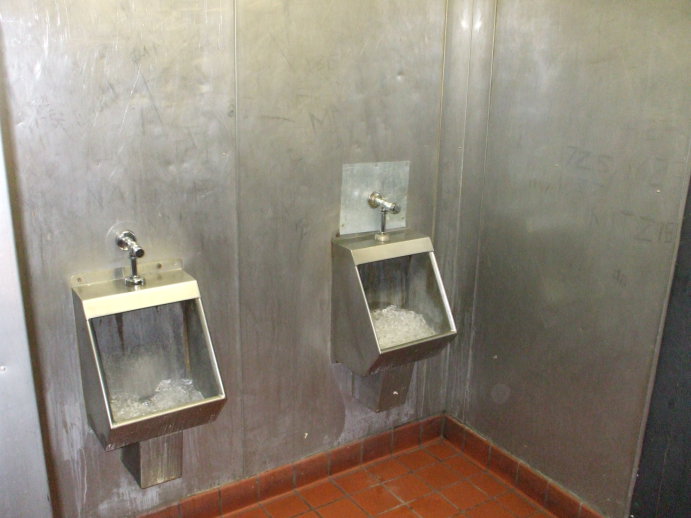
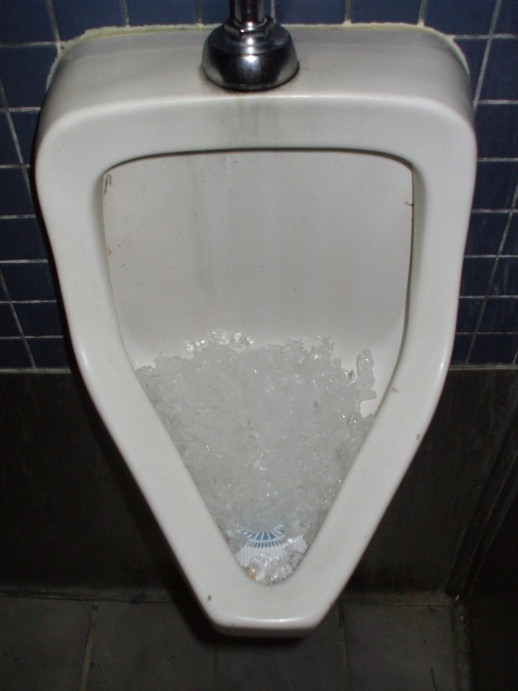
Ice-cooled ... Uh, wait... What?
Yes, some bars put lots of ice in their urinals.
This might be used ice, already used to chill bottles
and therefore dirty.
Or it might be excess ice, produced by their ice machines
but not needed.
Why put it in the urinals?
I'm really not sure.
But it has to go somewhere, and it would serve
to keep down the odor of a typical urinal.
I've only noticed this in the U.S., and it does seem like
an "only in America" sort of thing, this being the land
of the convenience stores and truck stops with
no beverages smaller than one liter.
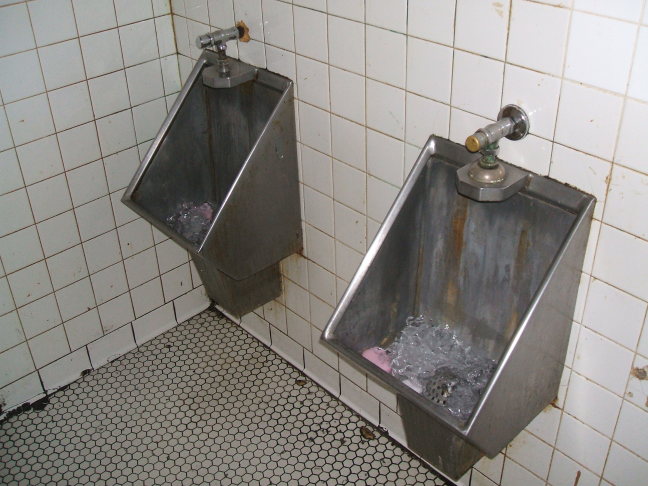
At left are the
ice-cooled
stainless steel urinals
in
Harry's Chocolate Shop
(actually a bar)
in West Lafayette, Indiana.
There are more pictures of
Harry's plumbing
on the
Stationary Toilets of the U.S.A.
page.
Also see the
Stainless Steel Toilet
page.
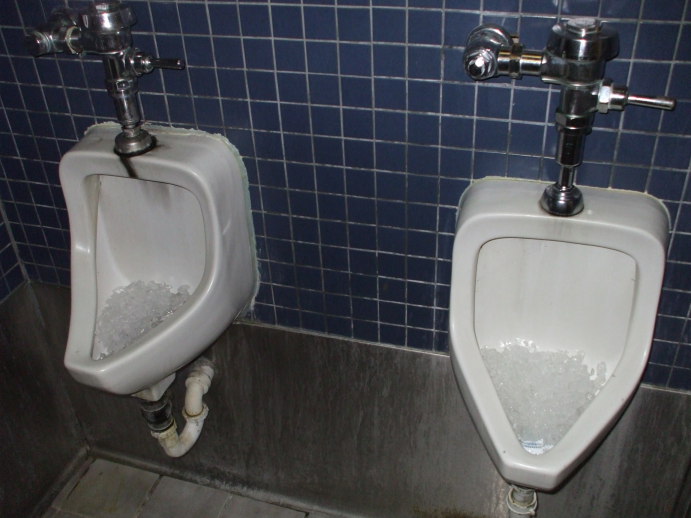
At left and below you see a pair of porcelain ice-filled
urinals at the Hawk & Dove bar in Washington D.C.,
on Capitol Hill just east of the Library of Congress
on Pennsylvania Avenue.
Rose George's
The Big Necessity: The Unmentionable World
of Human Waste and Why It Matters
is a fascinating description of sanitation conditions
around the world.
"2.6 billion people don't have sanitation. [....]
Four in ten people have no access to any latrine, toilet, bucket, or box.
[....]
Poor sanitation, bad hygiene, and unsafe water —
usually unsafe because it has fecal particles in it —
cause one in ten of the world's illnesses.
[....]
Diarrhea — nearly 90 percent of which is caused
by fecally contaminated food or water — kills a child
every fifteen seconds.
The number of children who have died from diarrhea
in the last decade [1998-2008]
exceeds the total number of people
killed by armed conflict since the Second World War.
In September 2009, Morna Gregory and Sian James published a book titled
Toilets of the World.
It's pretty much the same theme that you find here — photographs
and commentary on other people's plumbing.
The Porcelain God: A Social History of the Toilet,
by Julie Horan, contends that civilization began with the toilet.
Toilet: Public Restrooms and the Politics of Sharing,
edited by Laura Noren and Harvey Molotch,
has essays by anthropologists, sociologists, and architects on
the importance of the toilet, especially for urban dwellers.
Latrinae Et Foricae: Toilets in the Roman World
describes the toilets of the Roman Empire from Iberia to Syria,
and from North Africa to Hadrian's Wall in Britannia.
Toilets, Bathtubs, Sinks, and Sewers: A History of the Bathroom,
explains the history of personal cleanliness and hygiene to children
in grades 5-8.
|
|
A Sani-Flush blue border indicates a toilet that I've used.
|
How long have my Toilets of the World pages been around?
I'm not exactly sure, although they started in the mid 1990s
as a single page on a Purdue University server.
The Internet Archive Wayback Machine lets you see
what that looked like as far back as January 17, 1999.
My cromwell-intl.com domain appeared in September, 2001,
although the Wayback Machine didn't notice its one enormous
Toilet of the World page until
January 17, 2002.
Some time soon after that I split it into categories,
and the collection has grown ever since.
In December, 2010 I registered the
toilet-guru.com
domain and moved the pages to a dedicated server.
If you're not bored yet, you might be interested in
(or at least tolerate):
|