
Glastonbury and its Arthurian Toilets
King Arthur
King Arthur was a legendary leader of late 5th and early 6th century Britain. There may have been a historical figure who led the Romano-British people against the invading Anglo-Saxons. Some documents link him to the Battle of Mount Badon, but all the documents mentioning his name date to the 8th century and later. Let's see just how much of what we think we know about King Arthur and the Round Table was real, and where the source of those legends may have lived and ruled. And, of course, how that relates to medieval toilets.
Most of what we "know" of Arthur comes from Historia Regum Britanniae or the History of the Kings of Britain written in the 1130s by Geoffrey of Monmouth. Chrétian de Troyes then added Lancelot and the Holy Grail to the story. These stories were immediately popular and many new "Arthurian" stories were written in continental Europe, especially in France, in the 12th and 13th centuries.
VisitingGlastonbury
The Island of Avalon was soon associated with the low-lying marshlands of Somerset, where a hill like the Glastonbury Tor was much like an island rising out of the wetlands.
All of this myth, much of it of recent invention, centers on Glastonbury.
Glastonbury and its Abbey
Glastonbury Abbey was founded as a monastery in the 7th century. The town fell to the invading Saxons in 658, they may have intended to seize control of the valuable abbey. However, the Saxon leader allowed the British abbot to remain in charge of the abbey. That abbot was replaced by an Anglo-Saxon, but British monks remained in residence at the abbey for several years.
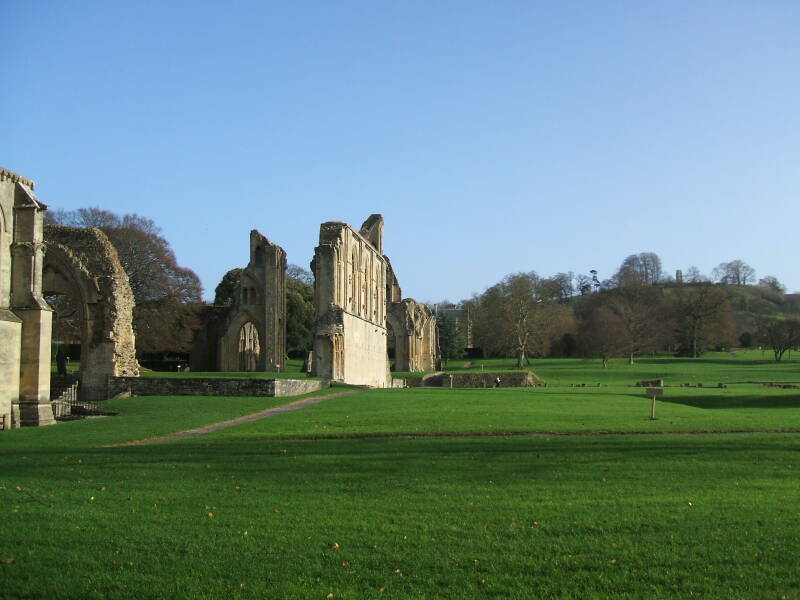
Ruins of the Great Church at Glastonbury, with the Tor in the distance at right.
There are legends claiming that Glastonbury was a religious center in Celtic or even pre-Celtic times, but many of the legends about Glastonbury are nothing more than wishful speculation. The founding of the abbey in the 600s and its subsequent capture by the Saxons is as far back as we really know about any religious traditions here.
The Saxons under the leadership of Cenwalh took control of Somerset as far west as the River Parrett. Cenwalh allowed the British abbot Bregored to remain in charge of the abbey. He died in 669 and was replaced by Berhtwald, an Anglo-Saxon, but the community of monks remained largely British for many years.
King Ine of Wessex supported the established community of monks, directing the construction of a stone church in 712.
Saint Dunstan, the abbot of Glastonbury, was a central figure in the revival of monastic life in Britain in the 10th century. He enlarged the abbey church, built new cloisters, and established the Benedictine Rule at Glastonbury. He went on to become Archbishop of Canterbury in 960.
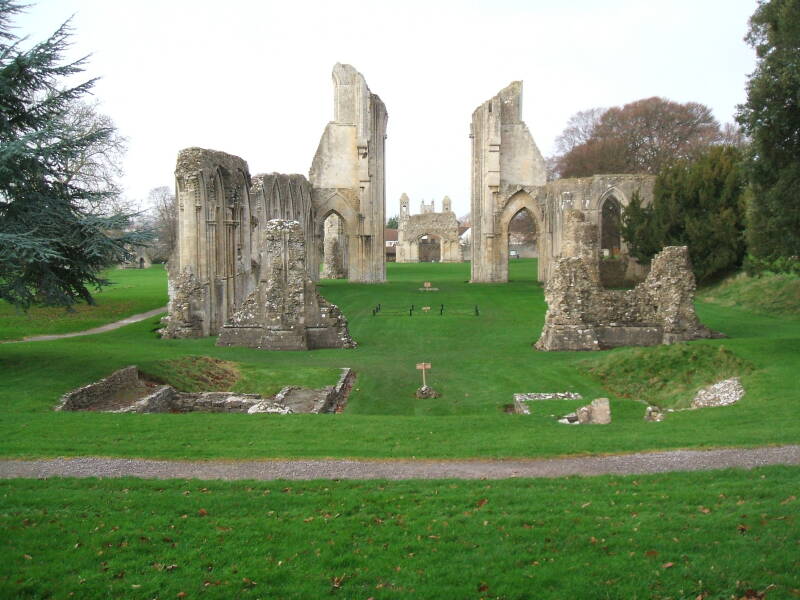
Ruins of the Great Church at Glastonbury, looking from the apse toward the entrance.
The abbey passed into Norman control after the Norman Conquest in 1066. The new Norman abbot expanded the church. The Domesday Book was compiled in 1086 to inventory the newly Norman England. It recorded Glastonbury as the wealthiest abbey in the country.
Glastonbury Abbey and King Arthur
A huge fire destroyed the buildings of Glastonbury Abbey in 1184. Reconstruction began immediately, with the rebuilt Lady Chapel consecrated in 1186. The enormous new church was under construction, with parts of the walls of the aisle and crossing completed by 1189.
Note that it's a church and not a cathedral, as the second term is reserved for the seat of a bichop. It's tempting, but incorrect, to refer to a large church as a cathedral simply because of its size.
In 1191 the reconstruction had the abbey under financial pressure. The abbot directed the monks to dig in a particular spot in the cemetery, where they found a large oak casket holding a man and woman. Obviously this was Arthur and Guinevere!
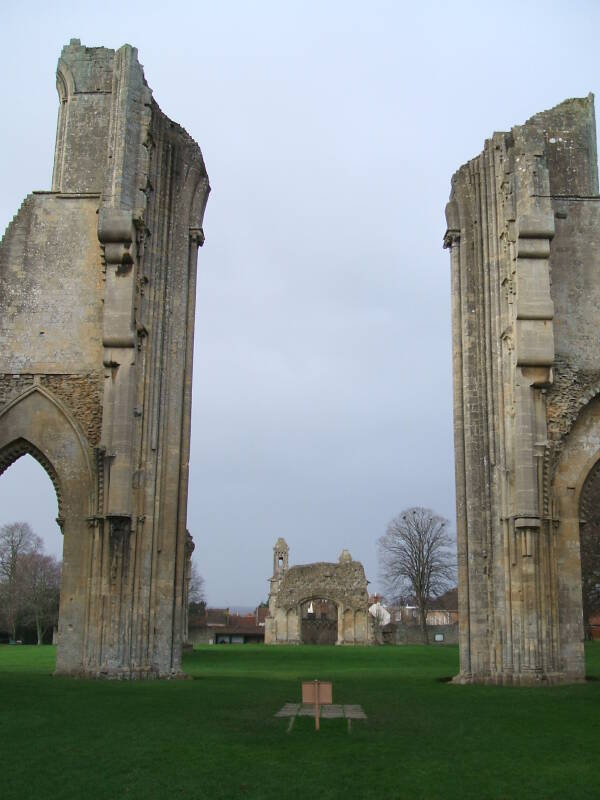
Purported grave of Arthur and Guinevere near the High Altar in the Great Church at Glastonbury.
Well, there was said to be a lead cross enscribed in Latin, "HIC JACET SEPULTUS INCLITUS REX ARTHURUS IN INSULA AVALONIA" or "HERE LIES INTERRED THE FAMOUS KING ARTHUR ON THE ISLE OF AVALON". So the two bodies were moved to a new tomb in what was then a fairly new large abbey church. And so today you can stand in one spot and see two tombs of Arthur and Guinevere.
Amazon
ASIN: 0319240193
Both graves are clearly marked, but for detailed advance planning or finding them with the appropriate Ordnance Survey map, here are their coordinates:
| Original | |
| British Grid | ST 49993 38819 |
| UTM | 30U 0519843 5666142 |
| Lat/Lon | N 51 08.783' W 002 42.979' |
| New | |
| British Grid | ST 50103 38843 |
| UTM | 30U 0519954 5666168 |
| Lat/Lon | N 51 08.797' W 002 42.884' |
Arthurian Toilets
To the north-east of the abbey church and just beyond the monks' quarters is a plumbing contraption with a mysterious sign REREDORTER. Elsewhere a map labels it Rere Dorter. This obscure term specifically means the latrine associated with a monastic establishment, which is usually located behind the dorter or sleeping quarters.
The medieval term was necessarium. In the 19th century, possibly because that name was too obvious for the overly squeamish Victorian sensibilities, the term reredorter was coined. It comes from the Middle English prefix rere- (from Anglo-French) meaning "behind" and the medieval term dorter for the monastic dormitory.
See the glossary of Christine Powell's A Matter of Convenience for more medieval through early modern toilet terminology and the historical background of sanitation in the 17th century.
The monastic dormitory was typically built on the east side of the main cloister, and its necessarium was usually attached to its south or east side, putting it along the dormitory walls furthest from the church.
This monastic latrine is fed by small pipes entering at the upper end (right foreground in the first image, closest to the viewer in the last image). That flow was separated into two channels down either side of the structure. I imagine a large open room with rows of toilets down the opposing long walls. The channels then join and disappear into a drain that ominously leads toward the abbot's kitchen (the conical structure seen in the last image). This is not a good sanitary design, putting your group toilet uphill from the kitchen!
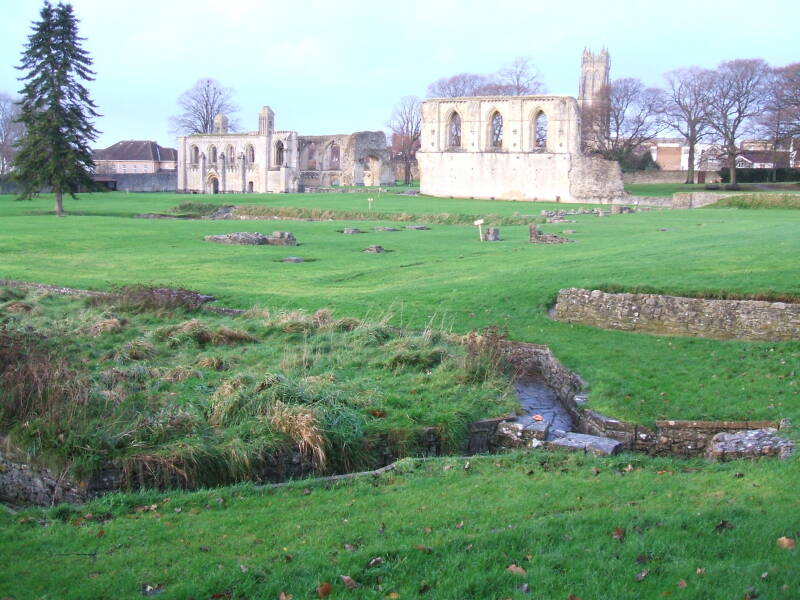
Looking over the necessarium toward the abbey.
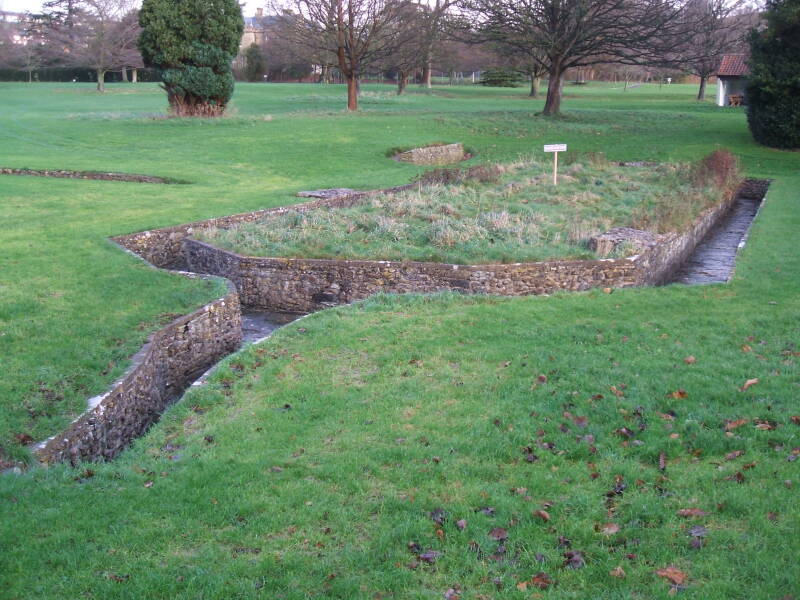
Looking over the necessarium.
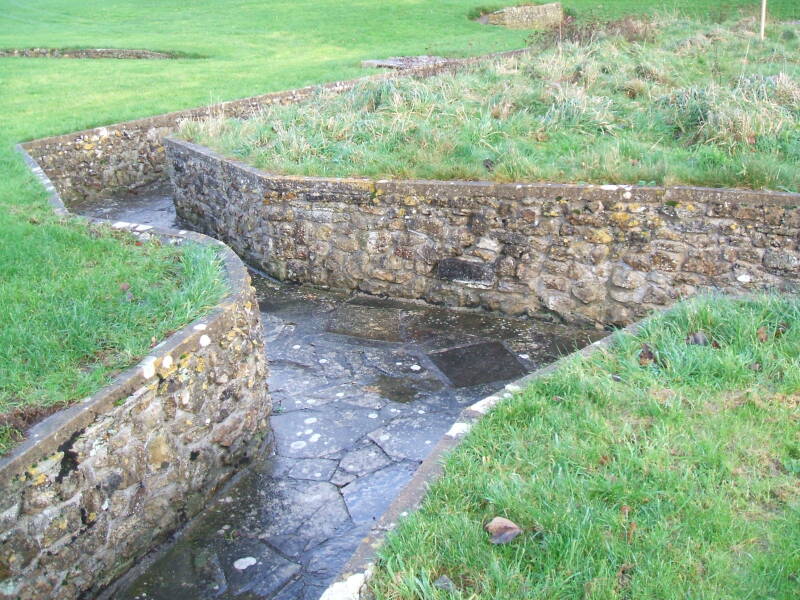
Detail of the necessarium.
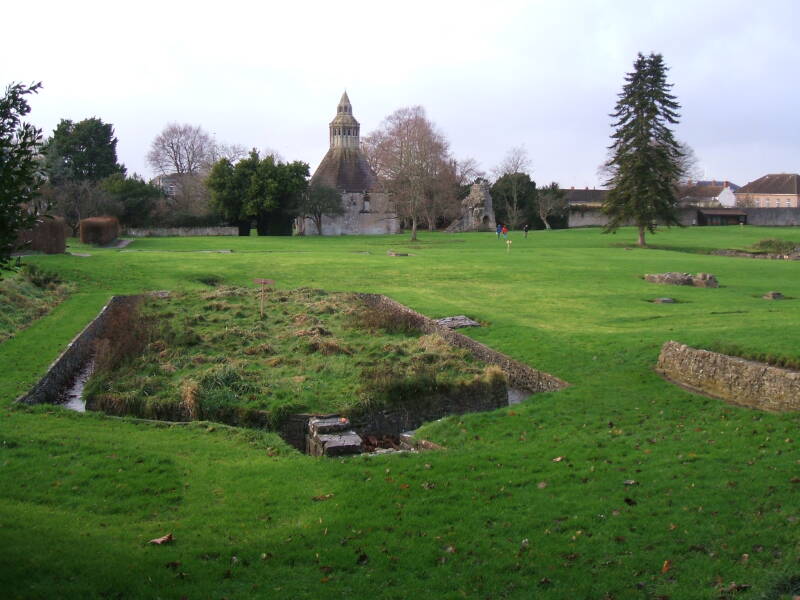
Looking over the necessarium toward the kitchen.
Tradition dates the establishment of the abbey to 63 AD and the visit of Joseph of Arimathea. But the idea that Joseph of Arimathea visited Glastonbury only appeared in the 12th century and later with the other legends of Arthur.
In September 1539 the abbey was stripped of its valuables, and the abbot was hanged, drawn and quartered in 1539. This was during the Dissolution of the Monasteries in England, 1536-1541.
It wasn't until the 1800s that people again became interested in the Arthurian legends.
Also see the Medieval Scottish Toilets page for other ecclesiastical toilets of similar vintage.