
Toilets of Christian Sites
Toilets of Christian Sites
So you're wondering,
"How did people in the Bible use the toilet?"
Well, that depends!
If you're asking about Hebrew Bible times and the many
Jewish regulations on personal hygiene and public sanitation,
there's another page
explaining that.
But if you're asking about New Testament
or Christian times and locations,
you've come to the right place.
Asia Minor and the Levant had a largely Greek culture
thanks to the military campaigns of Alexander the Great
from 334 through 323 BCE.
Add to that the Babylonian idea of Šulak,
the "Lurker of the Latrine" or the "Demon of the Privy".
The Jewish community had picked up a belief in Šulak,
an "unclean spirit" blamed for both physical and spiritual
affliction, during their exile in Babylon.
They passed that along to the early Christian communities.
Meanwhile, the infrastructure including the water supplies
and sanitation was that of Hellenistic Greece and
the Roman Empire, followed by the Byzantine Empire.
Ephesus / Έφεσος
VisitingEphesus
These nice marble-topped public toilets are in the large public latrine near the Library of Celcius in Ephesus, in Asia Minor at the time and part of Turkey today.
Yes, that's me sitting on it. And my mom standing nearby — I was taking my parents around Turkey, and my dad took this picture.
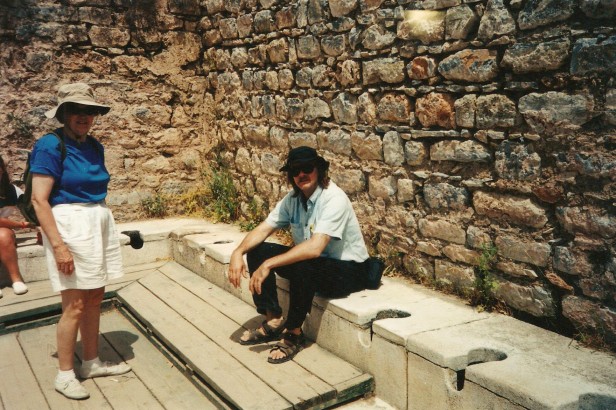
This category of toilet generally means public ones of Greek design. These were communal — no private stalls, but instead several closely adjacent seats on long benches. The flat-topped bench was executed in a variety of materials, although marble highly polished through use was perhaps the most elegant.
To most of us today, highly communal toilets with no privacy at all seem like a very simple, low-budget, and frankly unpleasant situation. "Better than nothing", you might say. "At least the poor people have a place to go."
However, see the essay on "Privies, Privacy and Power" for an explanation of how this communal design was actually for the elite of the period. Using the toilet in front of or in the company of others used to be a privilege of royalty and nobility.
This wasn't limited to Greek and Roman culture. It was the case throughout the ancient world continuing through European royalty into the 1800s, and even extended to a U.S. President in the 1960s. See "Privies, Privacy and Power" for more.
The long benches have one horseshoe shaped hole per "station".
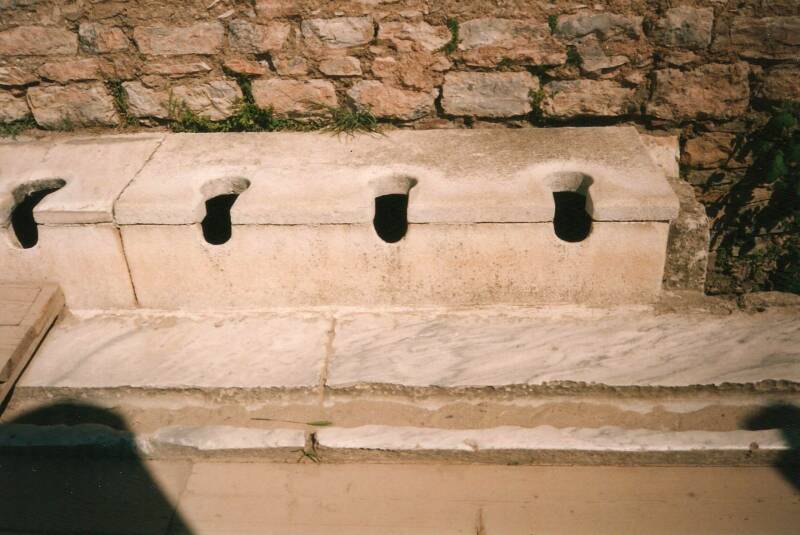
Below the bench was a channel for carrying away wastes. The channel varies widely in depth from one site to the next.
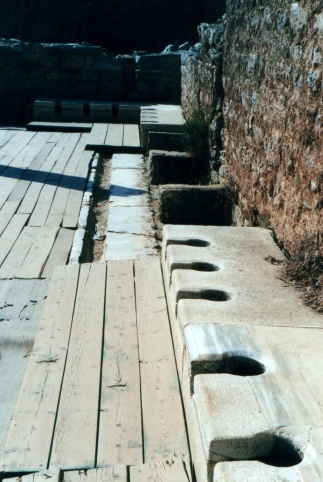
Immediately in front of the bench was a shallow channel carrying (relatively) clean flowing water. Compare this to the copper tubes on modern Turkish train toilets.
Europeans didn't have toilet paper until recently. The Romans, at least the higher classes, used a tersorium, also called a xylospongium, a sponge mounted on a stick. The sponge could be dipped into a water channel running in front of the row of communal toilets in the latrine, and rinsed off in that channel after use. If there was no channel of running water, a bucket of salt water or vinegar water would be used, as Seneca described in his Letters of Lucillus [70,20].
If neither a tersorium nor water were available, the Greeks and Romans used πεσσοι or pessoi, small stones, to clean themselves. The tradition started with the ancient Greeks that three stones should be enough to finish the job. This convention has been very long lived, with a hādīth attributed to Muhammad specifying three stones as the ideal number for anal cleaning. The pessoi were also used in an ancient board game in Greece. Aristophanes wrote a scene involving pessoi in Peace in the 5th century BCE. Here's the Penguin Classics translation:
Arms dealer [displaying a cuirass]: And what, alack, shall I do with this rounded cuirass, a beautiful fit, worth ten minas?
Trygaeus: Well, that one will not make a loss for you, anyway. Give me that at cost price. It will be very convenient to crap in ...
Arms dealer: Stop this impudent mockery of my goods!
Trygaeus [placing the cuirass on the ground like a chamber pot and squatting on it]: Like this, if you put three stones beside it. Is it not clever?
The Greeks would use όστρακα or ostraka, small pieces of broken ceramic goods, to vote to shun or ban their opponents. This is where we get the word ostracize. Some scholars have suggested that the ostraka could be used as pessoi, literally wiping your feces onto the names of hated individuals. The abrasive characteristics of broken ceramic material suggest that long-term used of these as pessoi could have resulted in localized irritation at the least, progressing to skin or mucosal damage or the irritation of external hemorrhoids. For more on toilet use of pessoi and ostraka and the medical implications see the paper "Toilet hygiene in the classical era", Philippe Charlier, Luc Brun, Clarisse Prêtre, and Isabelle Huynh-Charlier, in BMJ (the British Medical Journal) 2012, pages 345-346.
This large public toilet at Ephesus had a dozen seats on each of three sides of a room, so it was a 36-holer! Well, Ephesus was the major city of Asia Minor. This facility also has a remarkably deep waste channel, from about two meters deep (in the section shown here) to perhaps twice that on the other side of the room. Note how far the water channel is in front of the seat, you would have to lean very far forward to utilize it with your bare hands. But with your tersorium on a stick, no problem!
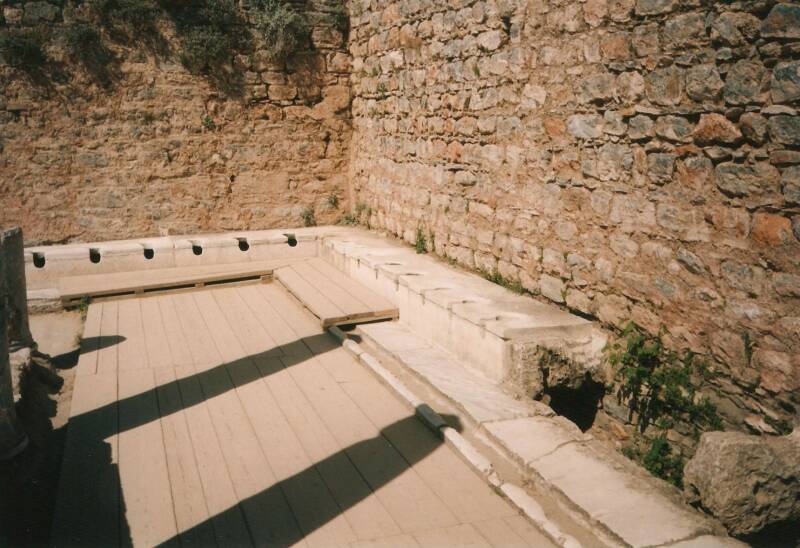
These toilets date from when Luke, Paul, John, et. al. were in Ephesus. Some of these pictures of mine were used in De Samenleesbijbel, Read the Bible Together, a Dutch study Bible for children of 8–12 years.
The settlement in that area was founded in the 10th century BCE, but was relocated to its final location in 292 BCE. The Goths destroyed the city in 263, but it was rebuilt under the Byzantines and was the second most important Byzantine city in the 5th and 6th centuries. It was sacked by the Arabs in 654-655, 700, and 716, after which it declined to a small village by the time the Seljuk Turks conquored it 1071-1100. The Byzantines recaptured control in 1100, changed its name to Hagios Theologos, and kept control until 1308. But crusaders passing through later found only a small village called Ayasalouk. See my travel page for more information and pictures of Ephesus.
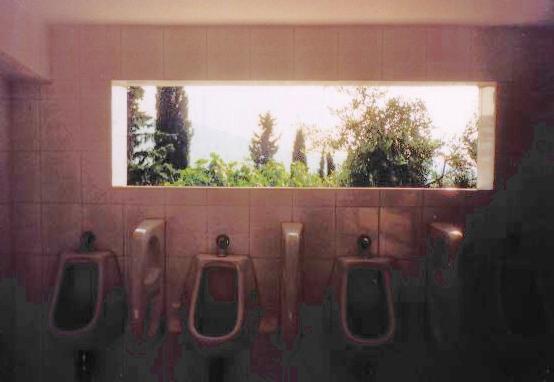
These surprisingly scenic urinals are at Maryemana, on a mountain above Ephesus. Also see the Middle Eastern section of this site for other Turkish plumbing. Someone else has photographed this one for another toilet-themed web site.
Corinthos / Κόρινθος
These are much rougher marble public toilets next to the main processional way from the harbor gate, in Corinthos, Greece.
These also date from when Paul was here, attempting to turn people away from the mountaintop debauchery at the Temple of Aphrodite, visible on the mountaintop in the distance. Presumably, the toilets were better enclosed back then. On the other hand, given that it took Paul two letters to work in all his exhortations about debased lifestyles in Corinthos, maybe they weren't.
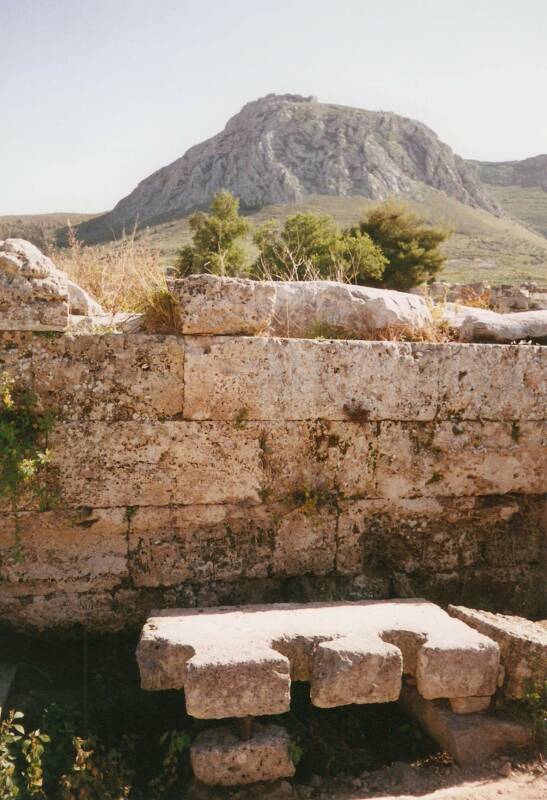
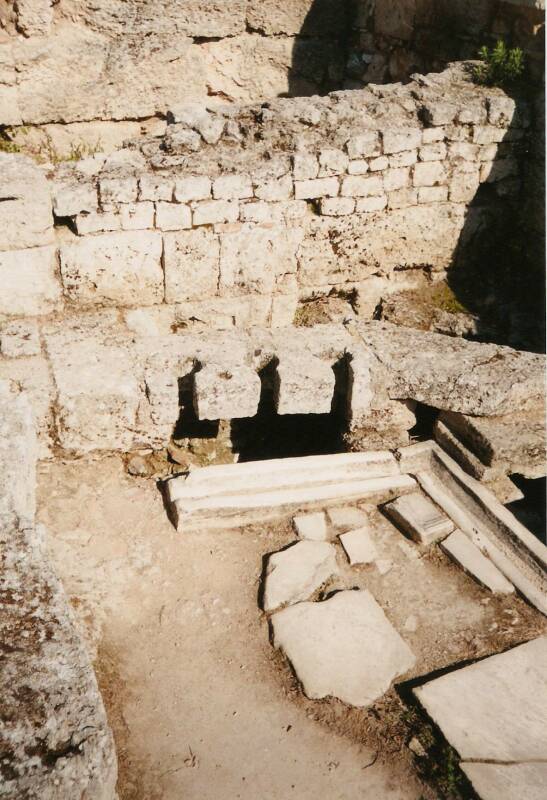
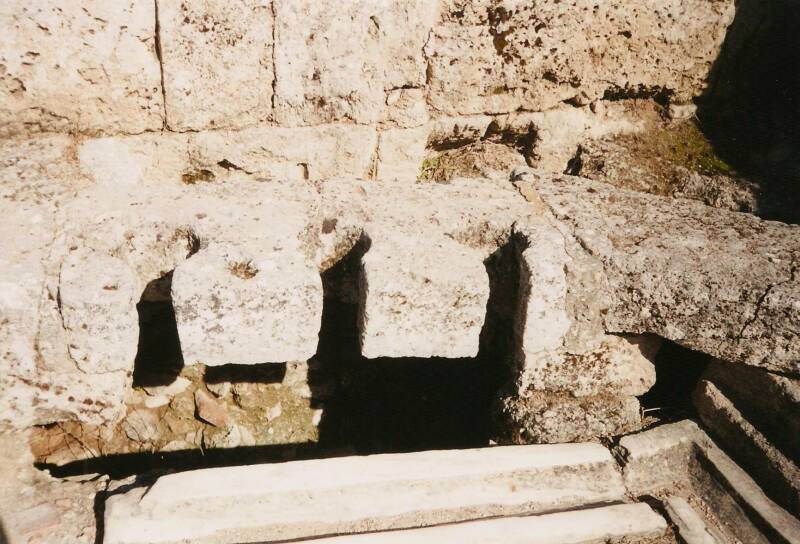
Corinthos was destroyed by the Romans in 146 BCE and re-founded in 44 BCE. It was destroyed by earthquakes in 375 CE and again in 551.
See my pages on travel in Greece for several more pictures of Corinthos, including the spectacular views from up there on top of Akrokorinthos at the ancient temple complex.
Hierapolis / Ίεράπολις
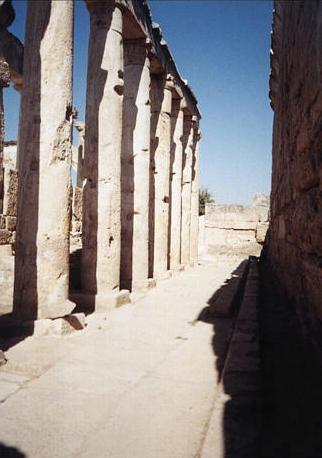
These are interior and exterior views of the public toilets at Hierapolis, then Asia Minor, now Pamukkale, Turkey.
Hierapolis was the site of the martyrdom of the disciple Phillip, and was also discussed in the closing chapter of Paul's Letter to the Colossians. Colossae, Hierapolis, and Laodicea were within 10-15 km of each other.
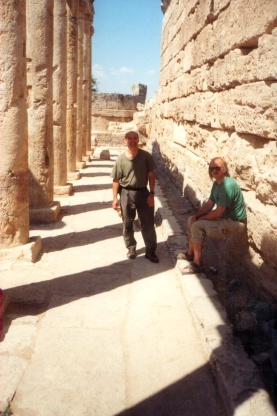
The interior images show the construction method clearly, as the bench seat is missing. And yes, that's me again, demonstrating where the seat would have been.
These images provide a clear view of the rather shallow drainage channel, against the wall to the right, and the cleaning water channel immediately in front of the seats. It obviously would have been more convenient to wash your hands in the Hierapolis facilities, although the deeper waste channel at Ephesus would have its own advantages.
Click here for lots of pictures and descriptions from my page of travel to Colossae, Hierapolis, and Laodicea
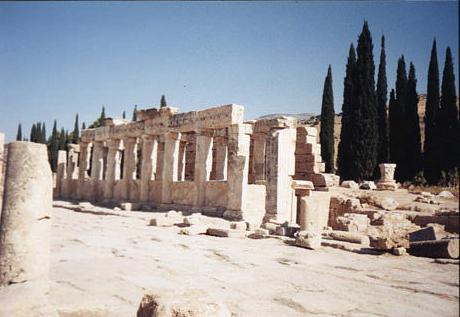
The Phrygians (and see the page on Hittite/Phrygians toilets) built a temple here in the early 200s BCE. It was destroyed from time to time by earthquakes and Persian armies. See my Turkish travel pages for more on Hierapolis.
Patmos / Πάτμος
The Revelation of Saint John the DivinePatmos is in the northern Dodecanese island chain, not far from the coast of Anatolia, today's Turkey. The short version of the story is that the Romans exiled John from Ephesus to Patmos, where he wrote Revelation, or as it's sometimes called, The Revelation of Saint John the Divine or other variations. The real story is much more complicated, and still only partially known. For example, how many Johns were there? The candidates include:
- John, son of Zebedee, a Galilean fisherman who became one of Jesus' initial twelve disciples.
- John the Theologian, who wrote the fourth Gospel of the New Testament, commonly called The Gospel of John.
- John the letter writer, who wrote three letters included in the New Testament commonly called the First, Second, and Third Epistle of John.
- John of Patmos, who wrote Revelation.
- "The disciple whom Jesus loved"
- John who lived around Ephesus after around 33 CE, caring for Jesus' mother Mary as instructed to do so at the crucifixion.
The over-simplified version, what you might first encounter in a Sunday school class, is that they were all the same guy. At the other end of the debate, at least the first five and possibly the sixth were all different people, or possibly groups in the cases of authorship. The Wikipedia article on the authorship of the Johannine works seems like a good introductory overview of part of the problem, with plenty of links to authoritative resources. An uneducated Aramaic-speaking fisherman of Galilee wouldn't have known the sophisticated (to varying degrees) Greek of any of the written works. If you object that he could have with divine inspiration, there's no logical way forward.
Well, you're probably here for the plumbing and not the intractable historical and theological mysteries, so let's move on.
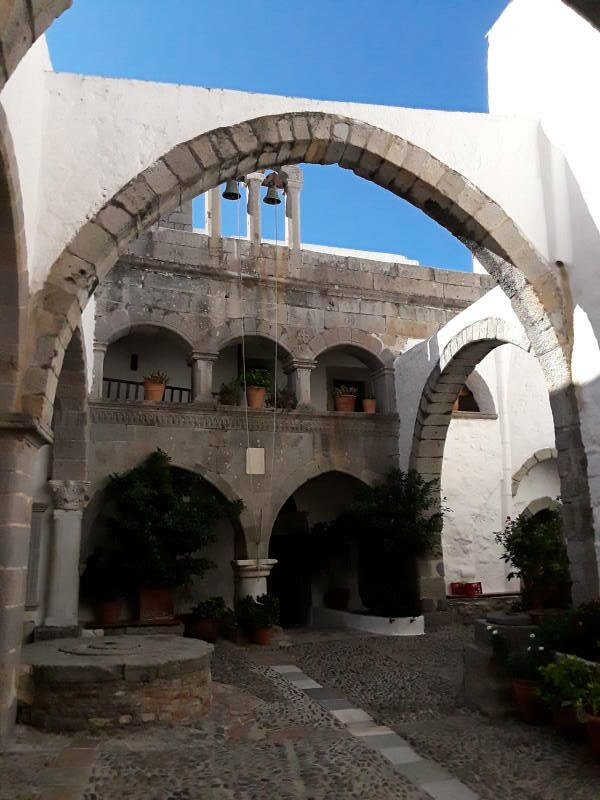
On smaller Greek islands (i.e., not Crete or Rhodes), the main town is usually named Χώρα or Hora. That means "Town". If the port is a separate settlement, is usually named Όρμος or Ormos. That means "Port". On Patmos, Hora is up at the high point. The port, however, is named Σκάλα or Skala. That means "Stairs", and is Greek foreshadowing. It's a 200 meter climb from Skala to Hora, where we see the large Monastery of Saint John the Theologian on the horizon. It was founded in 1088, built on a 4th century church which itself was built on a temple to Artemis. Its position on the peak plus its castle-like structure protected it against raids.
The white structure about halfway from Skala to the peak is the Monastery of the Cave of the Apocalypse. A hermitage was built over the cave opening as soon as the main monastery was founded. The Monastery of the Cave of the Apocalypse has been expanded several times through the centuries, in the 21st century to add a serpentine ramp for wheelchair access.
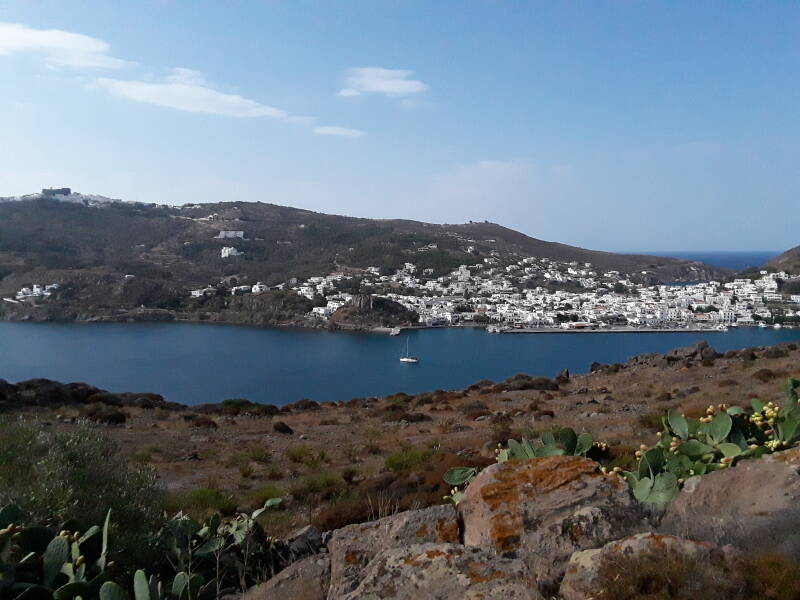
Follow Skala's main street south from the port and watch for the sign showing the path to Σπήλαιο της Αποκάλυψης, the Cave of the Apocalypse. Or, for a longer and less steep route, but with traffic, stay on the edge of the road and keep climbing.
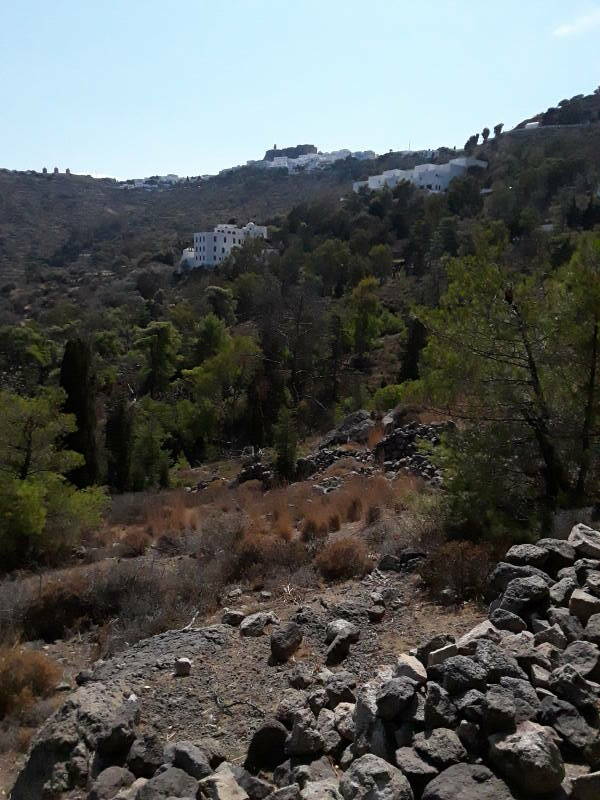
Entering the monastery complex, there is a washbasin with a spectacular view down over the port.
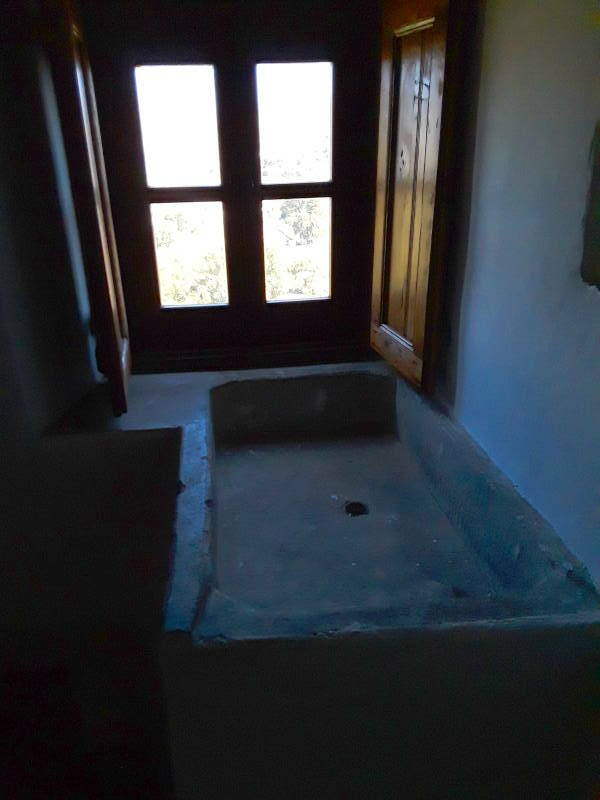
Then, a communal wash basin as you approach the holy cave. This is a working monastery. Clean up before entering holy space! You can visit every morning from 0830 to 1330, and then from 1600 to 1800 on Sundays, Tuesdays, and Saturdays. Otherwise, it's closed to the public and active with prayers and services.
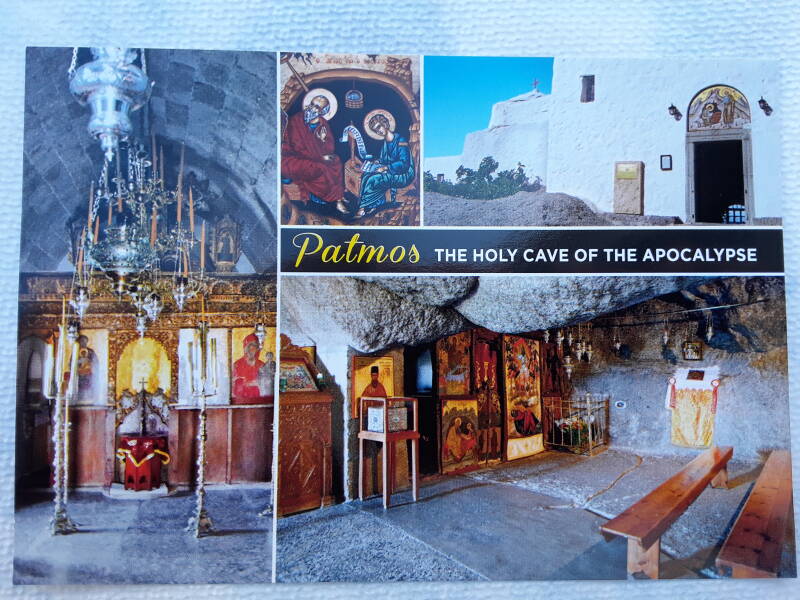
Or at least initially, a photograph of a postcard. I wrote the first draft of this section sitting on the balcony of my room in Skala, looking uphill to the Monastery of the Cave of the Apocalypse and, beyond that, the Monastery of Saint John the Theologian.
Photography is prohibited within the cave itself, so here is a scan of a postcard.
Certain embellishments have been made. John has been given a scribe Πρόχορος or Prochoros. The rear wall of the cave has two niches in its nearly vertical wall, which makes a 90° turn to an unnaturally horizontal floor. The larger niche, barely above the floor, is said to have been where John laid his head to experience the visions. Above that, the smaller niche is the holy hand grip he used to get up and down from the vision sessions. Both are now framed in silver, the lower one fenced off to prevent current-day use. None of this is mentioned in the original.
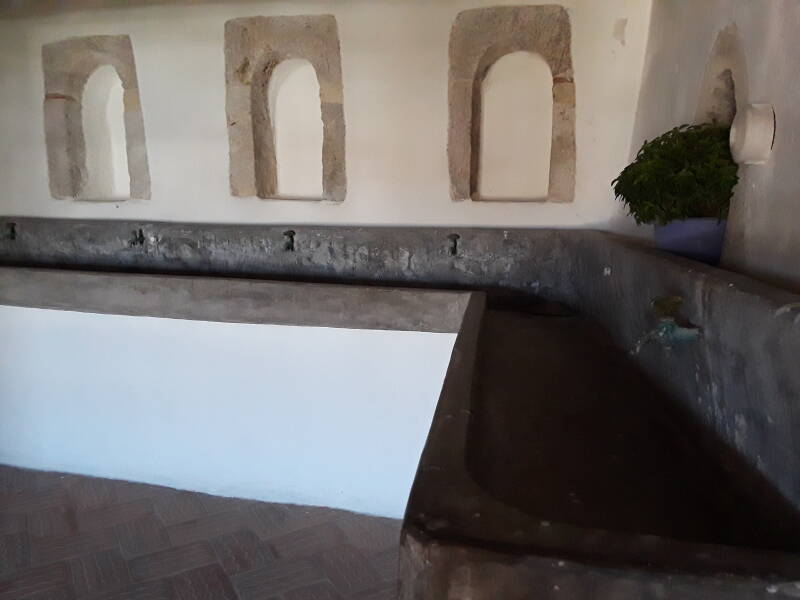
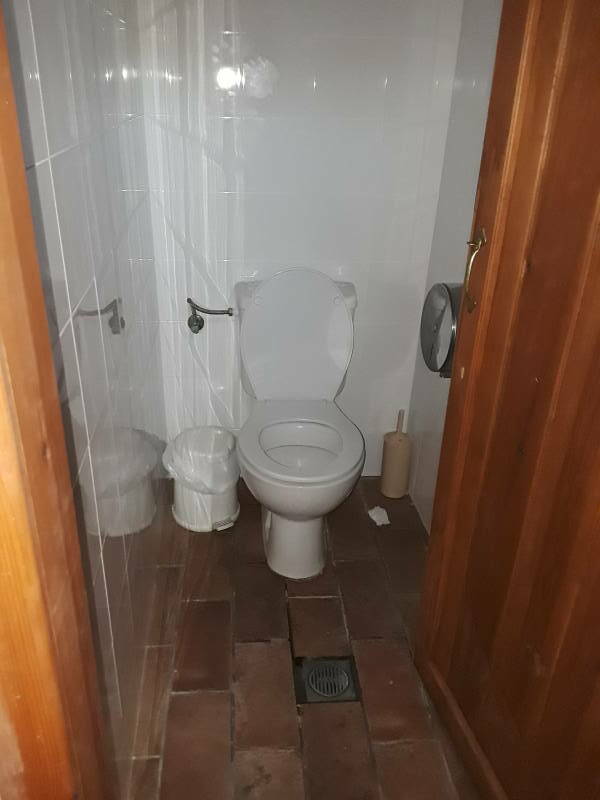
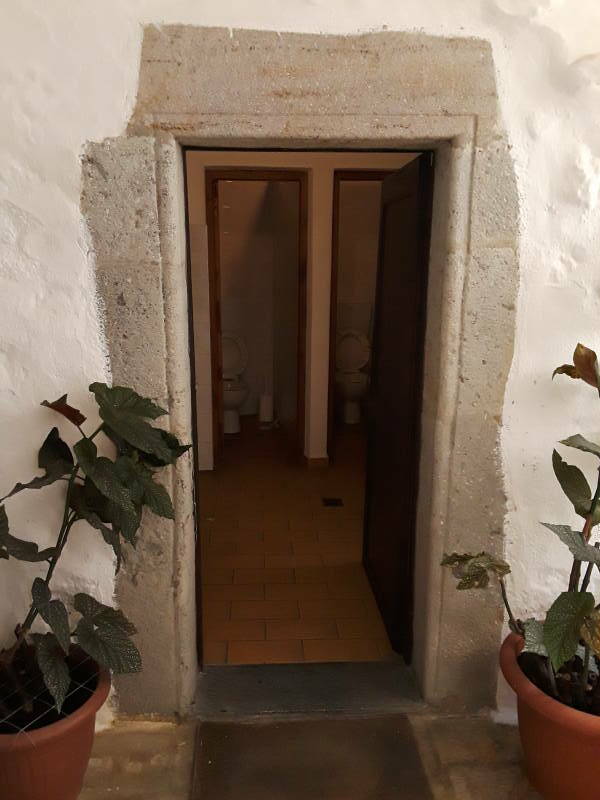
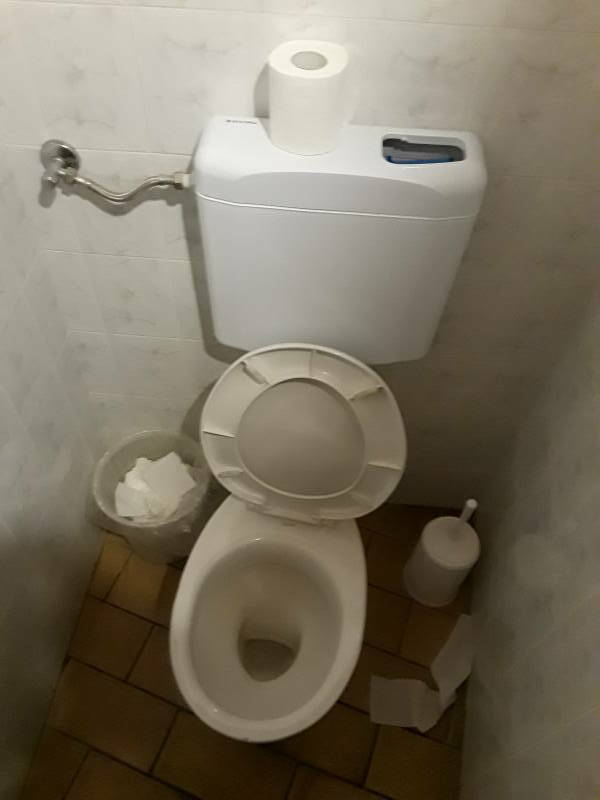
As for what the modern visitor can personally experience at the Cave of the Apocalypse, here are the public facilities for men.
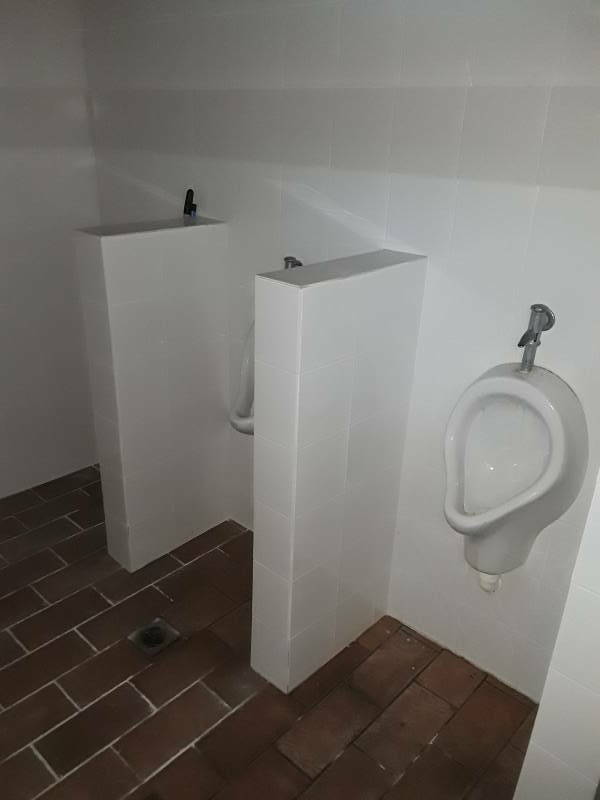
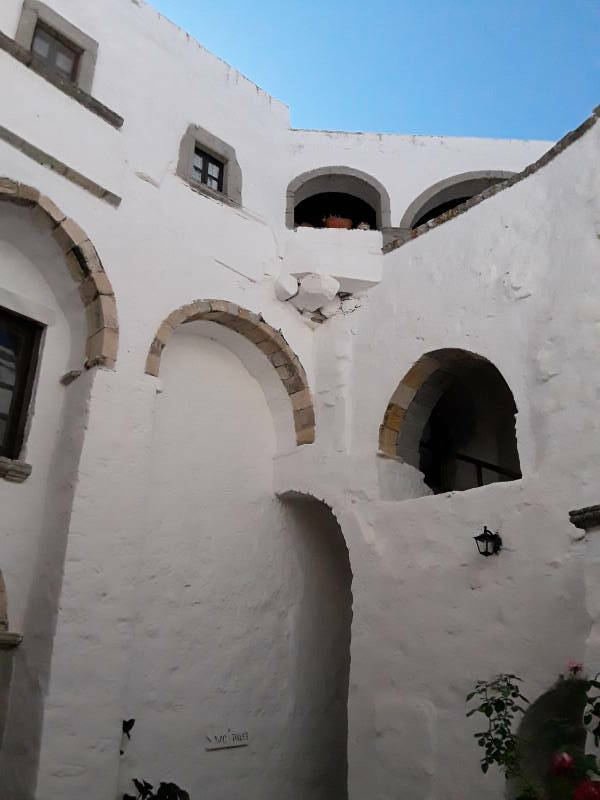
The Monastery of John the Theologian was founded in 1088, on the site of a church from the 4th century CE, which was in turn built on a temple dedicated to Artemis Patnia.
The public toilets are just off the refectory, see the above sign. There is a stall for men and another for women, and a shared washing area.
Thira
There's a nice hike along the caldera rim of Thira, also called Santorini. It leads from Fira, the main town on the island, to Oia at the northern tip. Along the way you come to Ναός Προφήτη Ηλία, the Church of the Prophet Elias. Chapels dedicated to Elias, commonly called Elijah in English, tend to be found on high points given the prophet's association with a mountain setting. And given that the Aegean islands are the peaks of mostly submerged mountains, except for Thira and Milos which are actually volcanos, there are many high points on which to build another chapel dedicated to Προφήτη Ηλία.
The Book of Kings describes Elijah's confrontation with King Ahab, the seventh king of the northern kingdom of Israel, and his wife Jezebel, daughter of the king of Tyre. Ahab built a temple to Ba'al, who was known as בעל to the Israelites, 𐎁𐎓𐎍 in Ugaritic cuneiform, 𐤋𐤏𐤁 in Phoenician, and Βάαλ to the later Greeks. Ba'al was a prominent deity of the ancient Levant.
Ahab also erected a pole for the worship of Ba'al's consort Astarte, a fertility goddess called Asherah in the Bible. Then he started fanatical religious persecution of the prophets of Yahweh.
Elijah, Priests of Ba'al and Asherah, and a Toilet DesecrationElijah organized a competition at the peak of Mount Carmel to show whether Yahweh or Ba'al was the stronger deity. Elijah was by himself against 450 prophets of Ba'al and 400 prophets of Asherah.
See the dedicated page for details of what happened, including the following retalitory shrine desecration involving an ancient toilet.
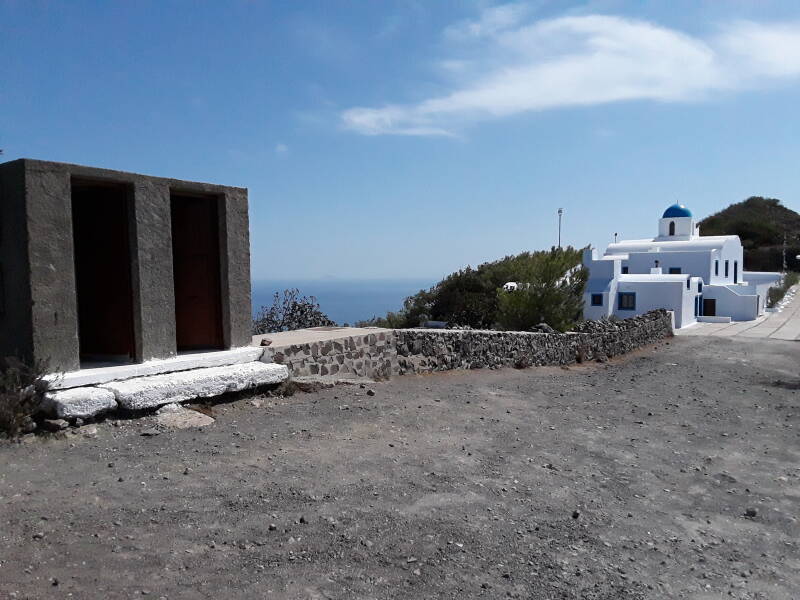
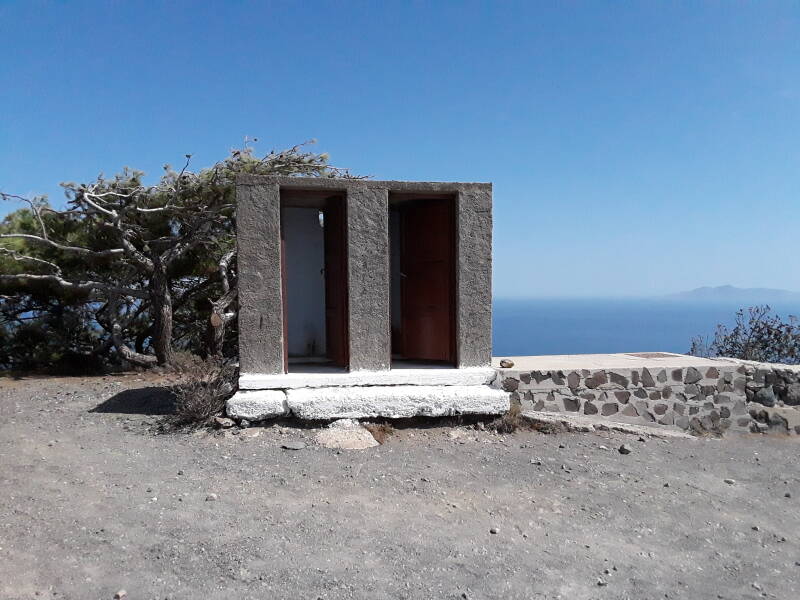
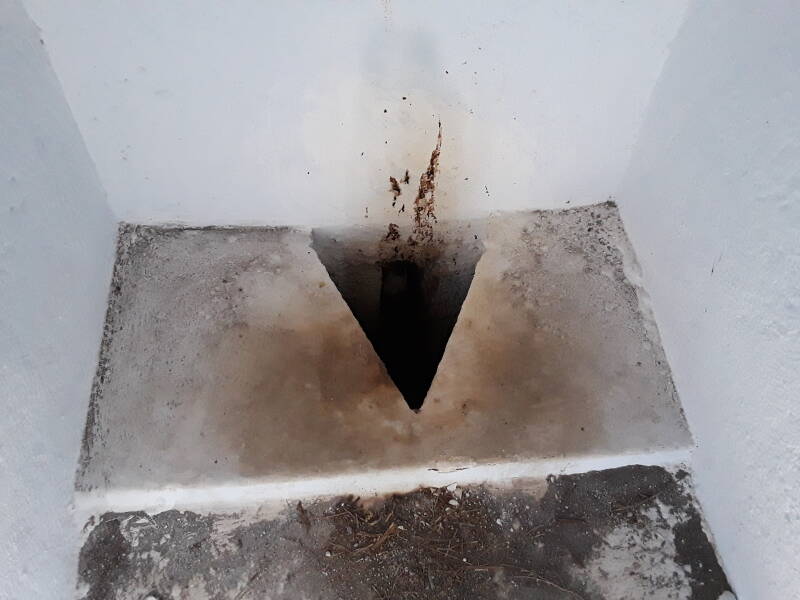
This church has a pair of squat toilets out in back.
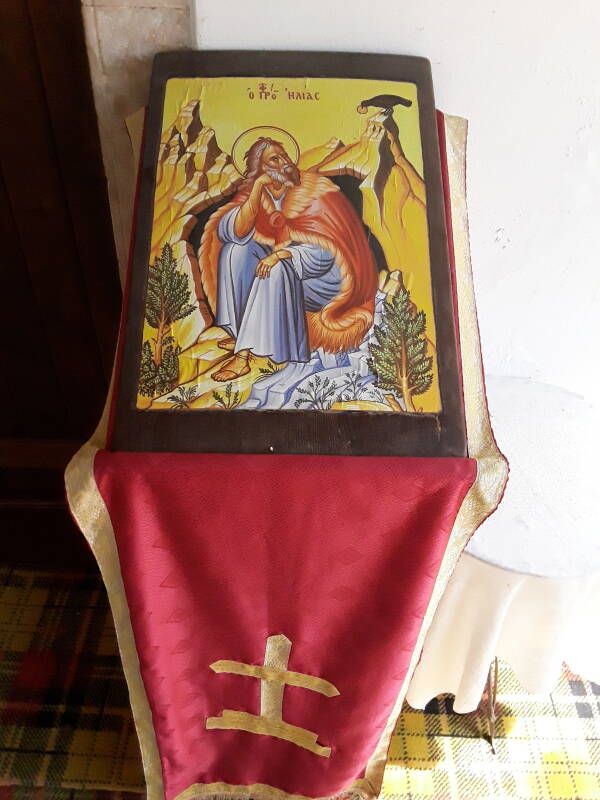
Elijah had won the competition, but Jezebel wanted him dead. He fled south to Judah, then on into the wilderness, and traveled forty days and nights to Mount Horeb, where Moses had received the Ten Commandments. Along the way he was fed by ravens. Below is an icon, a standardized representation of Elijah and a raven in the wilderness. This is in a different Church of the Prophet Elias. As it's an icon, you'll see a nearly identical one in many churches dedicated to Elijah.
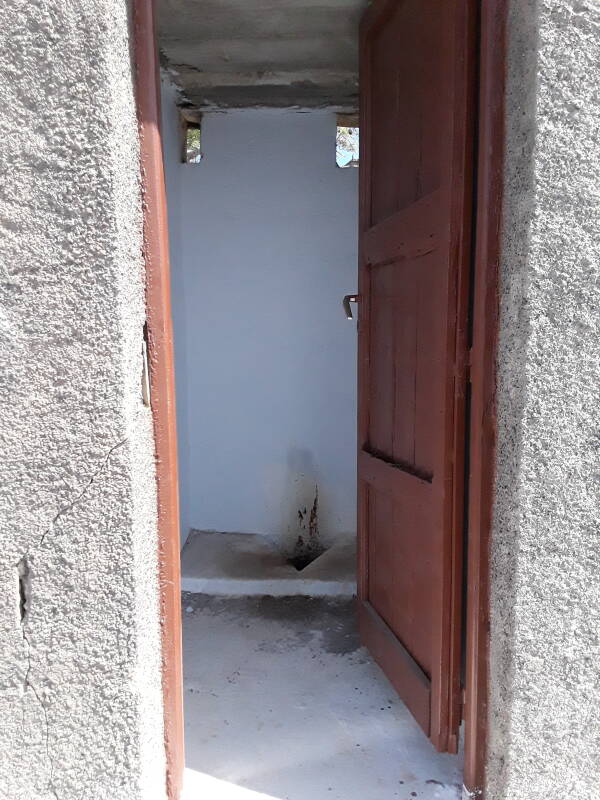
There's no flushing water, and no toilet brush to tidy up.
The Book of Malachi is the last of the Twelve Minor Prophets in the Hebrew Bible, it appears as the last book of the Old Testament in Christian Bibles. It describes how Elijah will return "before the great and awesome day of the Lord comes".
Toilets of theNew Testament
In the Christian New Testament, some think that John the Baptist is Elijah. Others think that Jesus is Elijah. Then Moses and Elijah appear with Jesus at his Transfiguration.
The Mormon church believes that Elijah returned on April 3rd, 1836, in Kirtland, Ohio, where he met with Joseph Smith and Oliver Crowdery, as described in Doctrine and Covenants, 110:13-16. Smith only had the King James Version of the Bible, which used the Hebrew transliteration "Elijah" in its Old Testament and the Greek "Elias" in its New Testament, leading to some confusion.
The Lurker in the Latrine, Epilepsy, and the Bible
Hippocrates and the Asclepeion of KosAlthough the physician Hippocrates (460-370 BCE) and other Greeks had done quite a bit for the practice of medicine, it wasn't the science that we know today. Magic and monsters still played prominent roles.
While exiled in Babylonia, the Jewish people had picked up the Babylonian idea of Šulak, the Lurker of the Latrine or Demon of the Privy. The "Lurker" category of demon in Babylonian thought lies in wait in places where potential victims are likely to be alone. A victim urinating or defecating is exposed and therefore vulnerable. "Šulak will strike him!", they say. The Babylonians seem to have gotten the idea for this demon from the Hittites, see about their toilets here. People of this era would describe a disease as the "hand" of a specific god, demon, or ghost, meaning that the ailment is the result of being struck.
The Babylonian mišittim means "stroke", a term which can mean a physical blow and which is also used to refer to a cerebrovascular accident or rapid loss of brain function due to a disturbance in the blood and thus oxygen supply to the brain. Stroke in the cerebrovascular sense was first reported in the 2nd millennium BCE. The cause wasn't known, so being struck down by a lurking demon was a good as any other explanation.
Amazon
ASIN: 9072371631
Amazon
ASIN: 0765761025
Hippocrates was the first writer to describe the sudden paralysis associated with ischemic stroke. He used the term άποπληξία or apoplēxia, meaning that the victim was "struck down with violence". English borrows his diagnostic term as apoplexy. It wasn't until 1658 that Johann Jacob Wepfer suggested in his book Apoplexia that people who died from apoplexy had bleeding in their brains.
Hippocrates also said that epilepsy did not have a divine origin but that it was a hereditary disease of the brain. Not everyone followed his view regarding epilepsy.
Cerebral stroke and epilepsy were closely related in ancient medicine and easily confused in the surviving writings.
Amazon
ASIN: 0300141165
This Demon of the Privy is the type of unclean spirit that people of the early Christian era regarded as the cause of both physical and spiritual affliction. Joel Marcus' Mark 8-16: A New Translation with Introduction and Commentary in the Yale Anchor Bible series discusses this. First, the text itself of Mark 9:14-29, where Jesus heals a boy described as epileptic:
9 14
And as they came to the disciples, they saw a great crowd
around them and scribes arguing with them.
15
And all the crowd, when they saw him, were immediately
awestruck, and they ran forward and hailed him.
16
And he asked them, "What were you arguing about with them?"
17
And one from the crowd answered him, "Teacher, I brought my
son to you because he has a mute spirit.
18
And wherever he is when it grabs him, it tears him, and
he foams at the mouth and grinds his teeth and becomes rigid.
And I asked your disciples to cast it out, but they didn't
have the strength."
19
And he answered and said to them, "O faithless generation,
how long will I be with you?
How long will I put up with you?
Bring him to me."
20
And they brought him to him.
And seeing him, the spirit immediately convulsed the boy,
and he fell on the ground and was rolling around foaming
at the mouth.
21
And Jesus asked his father, "How long has he been like this?"
And he said, "From childhood.
22
And many times it has thrown him into the fire and into
waters in order to destroy him.
But if you can do anything, have pity on us and help us!"
23
But Jesus said to him, "'If you can'?
All things are possible to the one who believes!"
24
The
father of the child immediately cried out and said,
"I believe; help my unbelief!"
25
And Jesus, seeing that a crowd was gathering together rapidly,
rebuked the unclean spirit and said to it, "Mute and deaf
spirit, I command you, come out of him and don't ever
enter him again!"
26
And shouting and convulsing him greatly, it came out;
and he became like a corpse, so that many people were saying
that he had died.
27
But Jesus seized his hand and raised him, and he arose.
28
And when Jesus had gone into a house, his disciples asked
him privately, "Why weren't we able to cast it out?"
29
And he said to them, "This sort of spirit can't be gotten out
in any way except by prayer."
The notes for verses 17 and 18 include:
a mute spirit. Gk pneuma alalon, that is, a spirit that prevents him from speaking. The boy appears to be an epileptic, as shown by Matthew's diagnosis (17:15) and by the correspondence between the boy's symptoms and other ancient descriptions of epilepsy (see Kollman, Jesus, 211-13; Wohlers, Heilige Krankheit, 21-23); on the epileptic's inability to speak during a seizure, for example, see Pseudo-Hippocrates, On the Sacred Disease 7:1; 10:6. According to Mark 9.25, the spirit is also deaf, a reflection of the epileptic's insensibility when undergoing a seizure.
In ancient paganism, epilepsy was often referred to as "the sacred disease," though there was no unanimity about the reason for this nomenclature; some thought it was because the malady was sent by a god, others because it attacked those who had sinned against a divinity, and still others because it could be healed only by divine intervention (see Aretaeus of Cappadocia, Chronic Diseases 1.4). Jews and Christians, however, avoided this terminology, not wanting to associate the deity too closely with such a terrible affliction; instead epilepsy was often attributed to demons (for an odd example, see b. Git. 70a, in which the epilepsy of a child is blamed on "the demon of the privy" that adhered to the child's father when he had sex too soon after relieving himself). Indeed, so close was the disease's linkage with possession in the popular mind that in later Byzantine times Christians simply referred to it as "the demon" (see Temkin, Falling Sickness, 86). Wohlers (Heilige Krankheit, 128-30) thinks that the demonological explanation of epilepsy first arose in Christian circles, but this thesis requires him to ascribe the first-century C.E. passage in Aretaeus to Christian influence without proof (cf. also T. Sol. 18:21[88]).
The demonological interpretation of epilepsy was doubtless influenced by sufferers' loss of control over themselves, the sense they conveyed of being victims of an attack from the outside—an impression still preserved in the modern English term "seizure" (see the NOTE on "wherever he is when it grabs him" in 9:18). Physicians, however, tended to reject such demonological explanations and to attribute epilepsy to a variety of physiological causes such as a superfluity of phlegm in the brain, disturbances in sexual function, climatic factors, and diet. The etiology of epilepsy, therefore, became a crucial battleground between the scientific and magical views of illness (see Temkin, Falling Sickness, 4). Nor has this conflict ended in modern times; for a sad case study of mutual misunderstanding in California in the 1980s, see Anne Fadiman's book The Spirit Catches You and You Fall Down: A Hmong Child, Her American Doctors, and the Collision of Two Cultures.
18. wherever he is when it grabs him. Gk hopou ean auton katalabḝ, lit. "wherever it grabs him"; the meaning is that the spirit attacks and convulses the boy wherever he happens to be, as subsequently happens in 9:20. The verb used here, katalambanein, has the same root as the verb from which "epilepsy" comes, epilambanein, which literally means "to seize." "In Greek, just as in modern speech, one would say of any disease that it has "seized" a man, and this terminology perhaps goes back to a very old magic conception according to which all diseases were believed "attacks" and seizures by gods and demons, as documented in Babylonian medicine. Since epilepsy was the demoniac disease par excellence, the term gradually acquired a more particular meaning and came to signify epileptic seizure" (Temkin, Falling Sickness, 21).
See the Toilets of the Hebrew Bible page for more on the origins of the Babylonian Šulak and the Talmudic analysis and Judaic latrine hygiene rules.