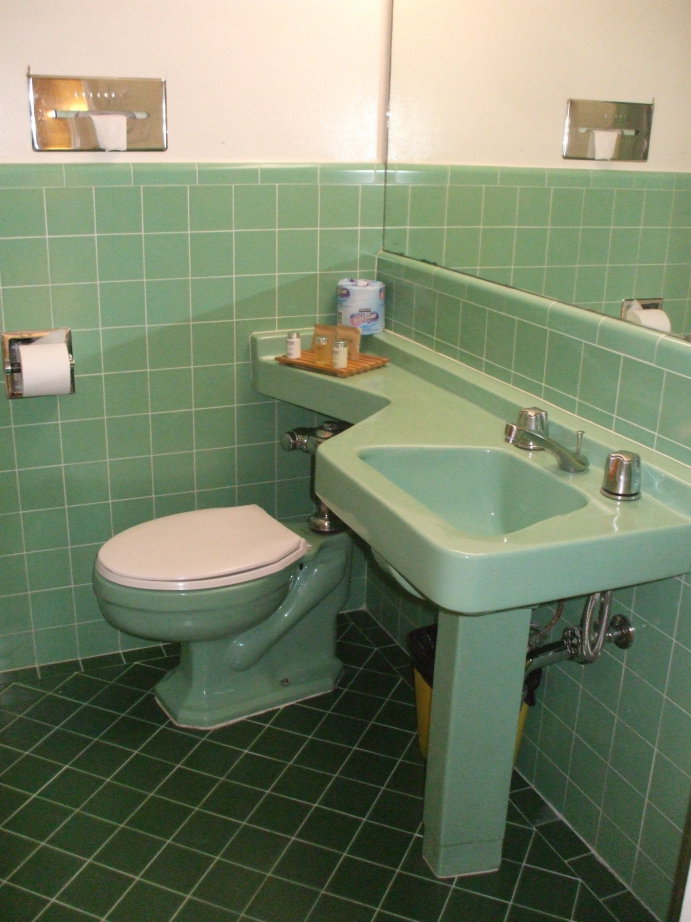
Historical Toilets
Toilets through History
This page provides a very brief overview of toilets throughout human history. Click on any of the pictures or descriptions to see many more pictures and detailed explanations of toilets and other plumbing from the various periods.
The toilets here are arranged by the starting year of each period, starting all the way back in the Stone Age.
10,000 — 2100 BCE
Neolithic Era
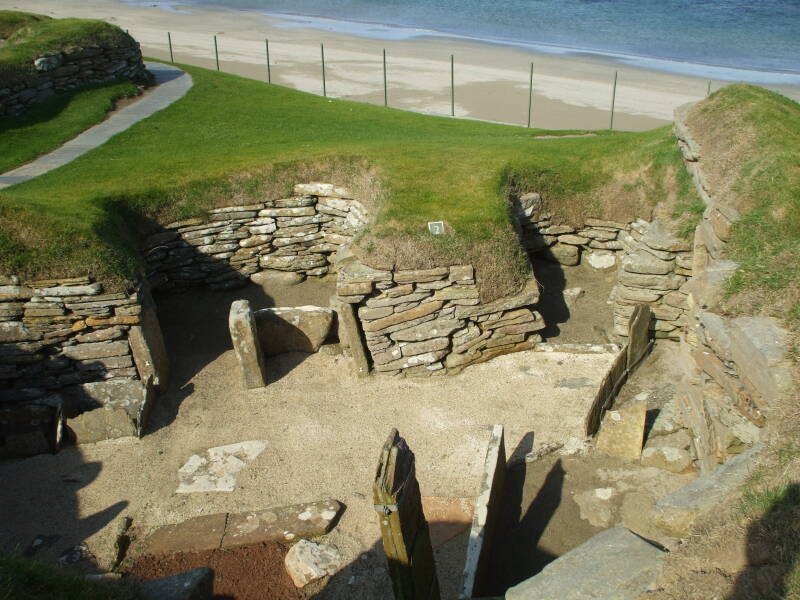
The Neolithic settlement of Skara Brae, in the Orkney Islands off the northern coast of Scotland, includes what are believed to be toilets attached to each of the eight interconnected dwellings.
10,000 — 2100 BCE
The Neolithic Era, literally meaning "New Stone Age" and referring to a period of a common technological level, extended over approximately 10,000 to 2100 BCE in Orkney. Skara Brae itself was occupied from 3100 to 2500 BCE. See the Neolithic Toilet page for several more pictures and further details.
3500 — 1100 BCE
Minoan Era
Minoan Plumbing3500 — 1100 BCE
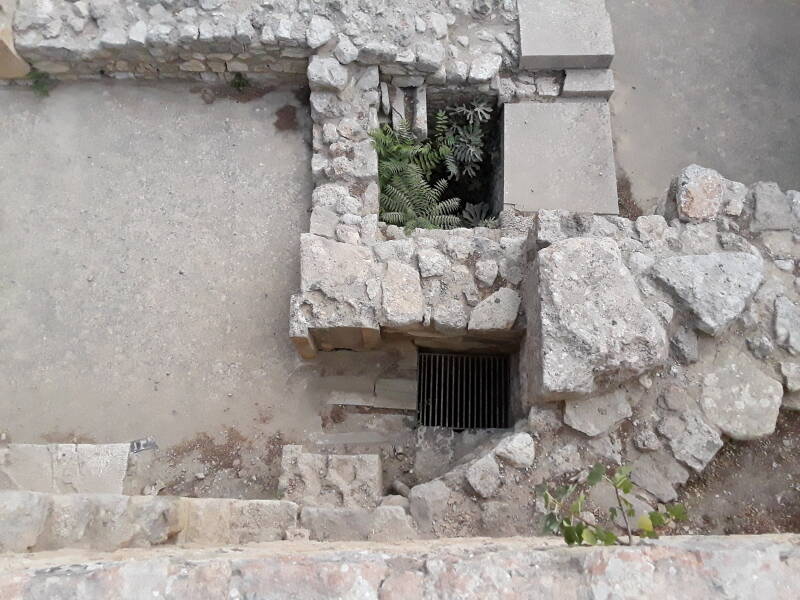
Below is the Queen's Toilet at the Palace of Knossos on Crete. Knossos had the first flushing toilets in Europe, possibly as old as those at Harappa and Mohenjo-Daro in the Indus Valley. The city also had terracotta water supply lines, and separated drains.
That is, one network of drains for sewage or septic waste, a second network to drain away rainwater. The rainwater can simply be drained away, at least the fraction that isn't captured in cisterns for drinking, bathing, and washing. Separated drainage is important for pollution control and public health. The Minoans had it by about 2000 BCE, while many cities in the U.S. still don't have it.
See the dedicated pages for Minoan plumbing at Knossos, Phaistos, Gortyn, Malia, and Amnisos.
3200 — 1600 BCE
Cycladic Era
Cycladic3200 — 1600 BCE
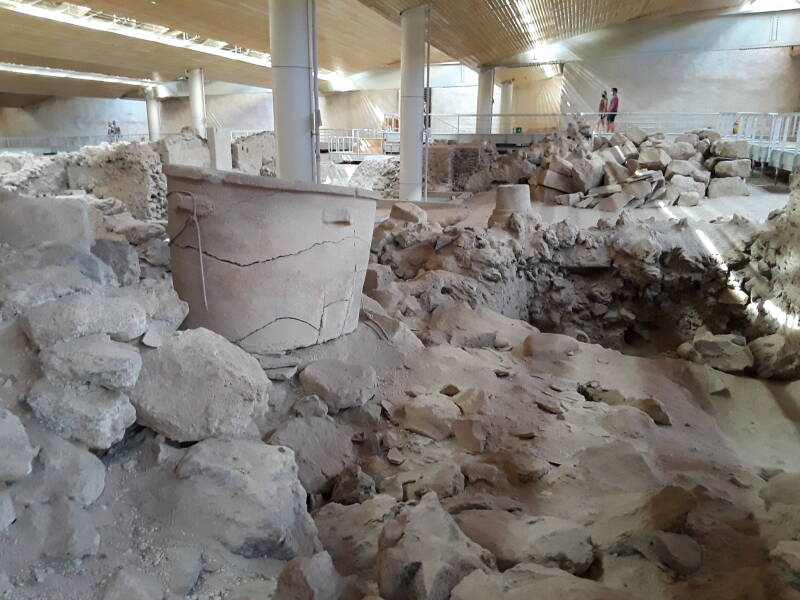
The prehistoric settlement of Akrotiri was on the south coast of Thira, frequently called Santorini by visitors. It was abandoned shortly before being destroyed in a cataclysmic volcanic eruption around 1600 BCE.
The people there had sophisticated plumbing, with toilets in homes connected to a municipal sewage drain, and what may have been a municipal system of both hot and cold running water. Plus bathtubs!
2100 — 1100 BCE
Mycenaean Greece
Mycenae, or Μυκήνες in Greek, was first settled by Neolithic people in the 6th millennium BCE. It's in the Peloponnese, south of Corinth and southwest of Athens in what today is southern Greece.
Between about 2100 and 1900 BCE, during the Old Bronze Age, Indo-European people crossed Anatolia, moved through Troy and on to the west and south through Greece. Existing settlements in the mainland were primitive, and the new arrivals brought an advanced culture. A number of small kingdoms were established.
The kingdom of Mycenae became the most powerful by far, leading to the entire civilization of that area being called Mycenaean. For the 400 years from 1600 to 1200 BCE, Mycenae was the most powerful kingdom in Greece.

It's hard to distinguish history from myth in Mycenae. But somewhere around the 14th Century BCE, there really seems to have been a King Agamemnon of Mycenae. Agamemnon's brother was Menelaus. According to Homer, Menelaus' wife Helen was abducted by Paris of Troy and taken back to his city on the northwest coast of Anatolia. Agamemnon then commanded the Achaean forces (what we often mis-label as "Greek" today) in the Trojan War.
Meanwhile, back in the royal citadel of Mycenae, the above pictures shows King Agamemnon's innermost royal chamber, and therefore the location of his chamber pot. Make that his Royal Chamber Pot.

2100 — 1100 BCE
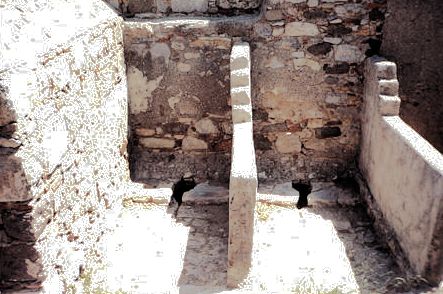
Above is the public latrine in the nearby fortress of Tiryns.
See the detailed Mycenaean toilet page for many more pictures and historical details of the two powerful city-states.
1600 BCE — 395 CE
Delphic Greece
Delphic Greek Toilets1600 BCE — 395 CE
Delphi, in Greece northwest of Athens, was a religious center for two millenia, from 1600 BCE until 395 CE. By 1600 BCE a shrine had been erected for Gaia, the Mother Goddess of west Asia, Then the myth held that the office of Oracle was held by the goddesses Themis and Phoebe. Later, the site was believed to be sacred to Poseidon, the deity of earthquakes known as "Earth-Shaker". During the Greek Dark Ages (11th-9th century BCE), the temple was turned over to Apollo.
This is the main temple in Delphi, the Temple of Apollo. The entrance to the temple was at the far or left end in this view.
The Sanctum Sanctorum, the Holiest of Holies, was at the opposite end, nearest the viewpoint in this picture. This was where the Oracle of Delphi sat on a tripod above a crevasse that emitted ethylene gas leading to the Oracle's strange mental states.
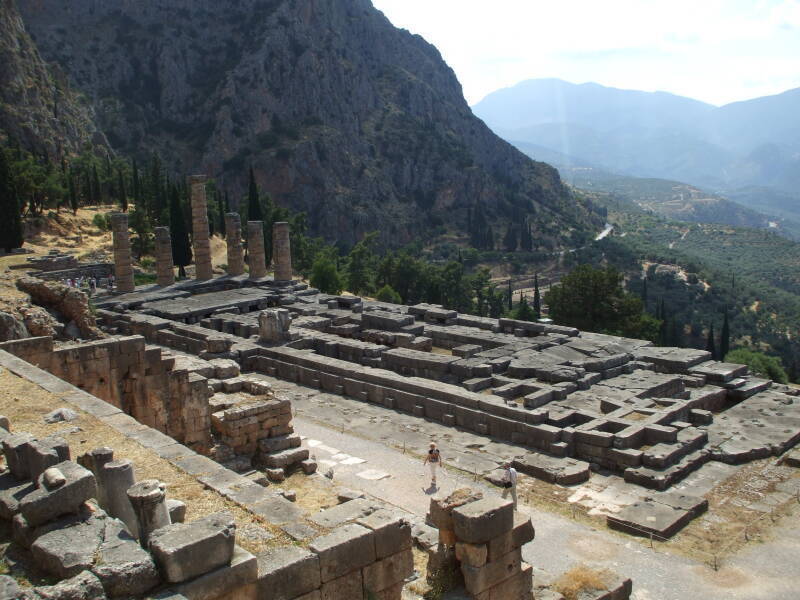
The Oracle would babble semi-coherently. Her ravings would then be "translated" by the temple priests into elegant hexameters.
The south side of the temple, the long downhill face, has a small passage leading back toward the area underneath the Oracle's seat! You can crawl back in there, I have pictures from inside that passage on the dedicated page about Delphi. But I had no visions.
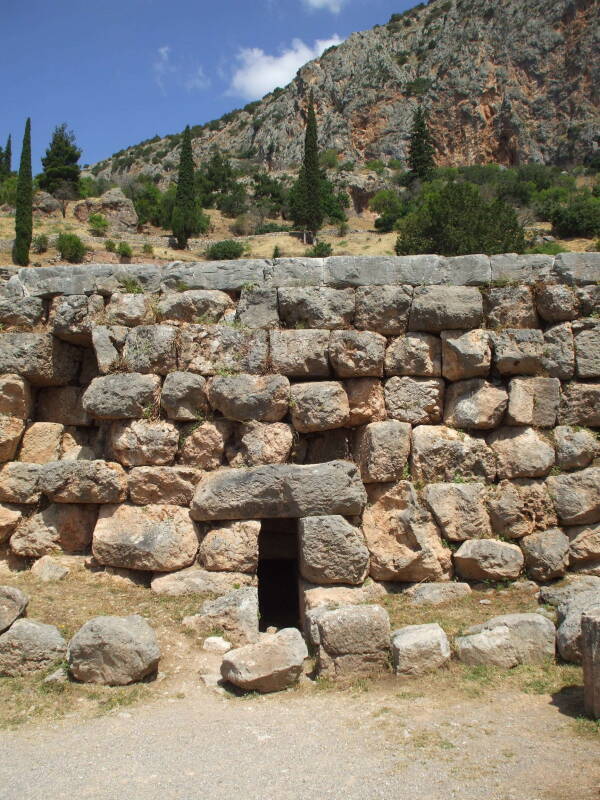
1600 BCE — 395 CE
Visitors did not just casually wander in to Delphi. Pilgrims would land at the Gulf of Corinth, several miles away, proceeding several miles up the valley toward the sacred site. They would purify themself on the way toward the sacred precincts.
The Castalian Spring and the sacred bathing area for cleansing purposes date back to Mother Goddess days, long before the Delphi of Classical Greek tradition.
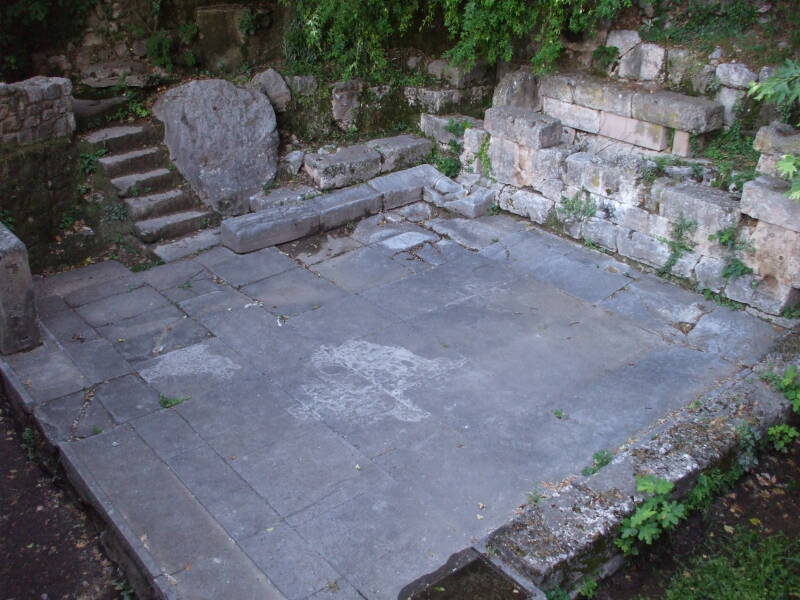
The detailed page about Delphi provides many more pictures and background.
Toilets of the Hebrew Bible
Toilets of the Hebrew Bible1400 BCE — 328 CE
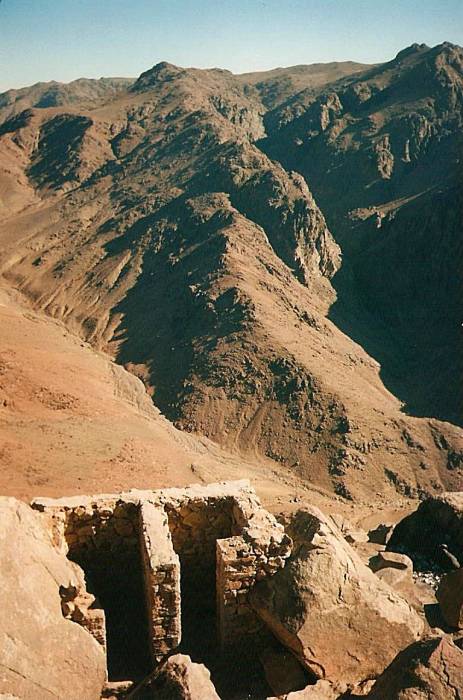
This pit toilet has been constructed from local loose stones, just below the summit of Mount Sinai, Egypt. The mountain has been a major pilgrimage site at least since when the Byzantine Empress Helena (ruled 313-328 CE) established a monastery at the base of the mountain.
1200 — 700 BCE
Phrygian / Hittite
The capital of the Hittite Empire was at Hattuşaş, next to today's small Turkish farming village of Boğazkale. After the fall of the Hittite Empire around 1200 BCE, the Phrygians established a capital there.
Phrygian / Hittite Toilets1200 — 700 BCE
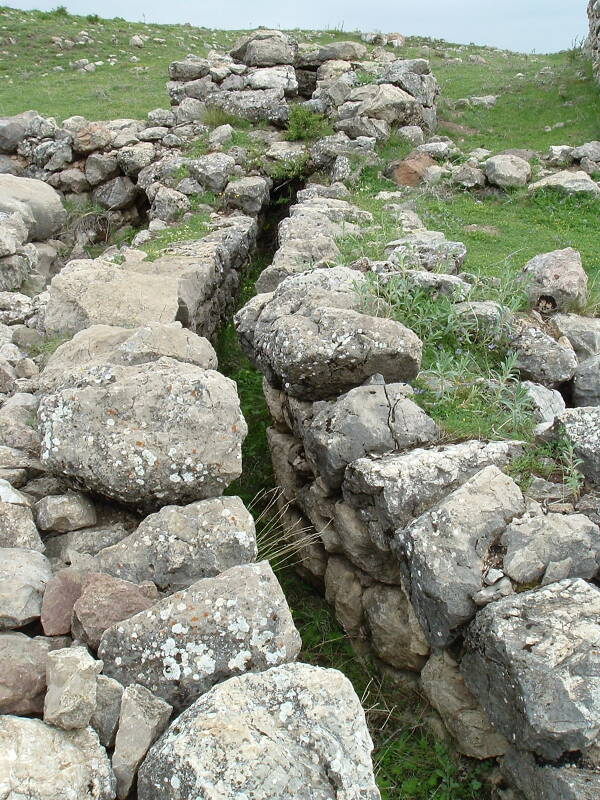
This sewage drain dates from the Phrygian occupation of the site about 1200-700 BCE.
The Phrygian people had a series of kings alternately named Gordias and Midas, as in the mythic Midas of the Golden Touch and the Gordian Knot. Phrygia itself fell under the Cimmerian invasion around 700 BCE, becoming part of Lydia, ruled by the proverbially wealthy King Croesus.
900 BCE — 100 CE
Delian Greece
After the Greek Dark Ages and the emergence of the Ancient Greek culture, the island of Delos became dedicated to the Ancient Greek religion. These are the famous lion statues on the Terrace of the Lions near the Sanctuary of Apollo. They were dedicated to Apollo shortly before 600 BCE by the people of Naxos.
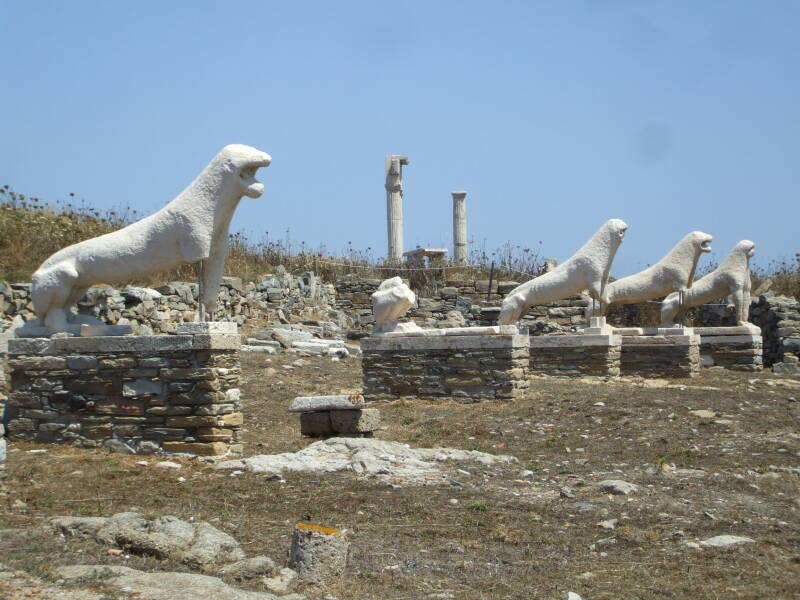
Delos was a major cult center from 900 BCE to 100 CE. It went through a number of cycles in which businesses would be established around the pilgrimage activity. At times it had the largest slave market in the region, and a number of large homes were built during these periods. But then the island would be "cleansed" of economic activity and re-dedicated purely to religion.
The Delian League started meeting here after its foundation in 478 BCE, after the Persian wars.
Delian Greek Toilets900 BCE — 100 CE
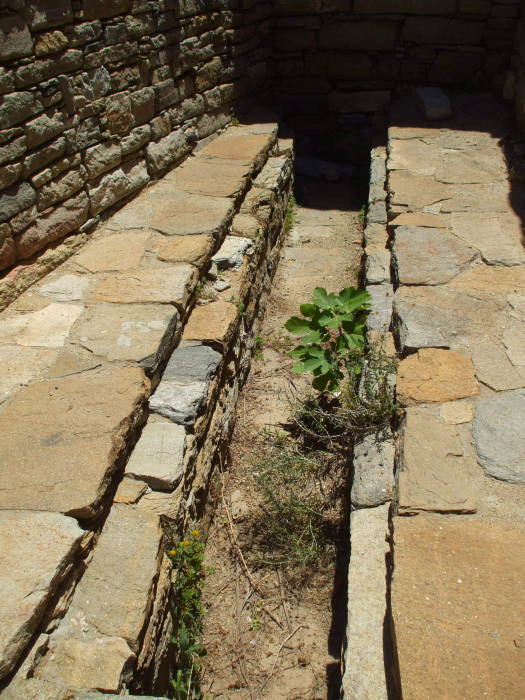
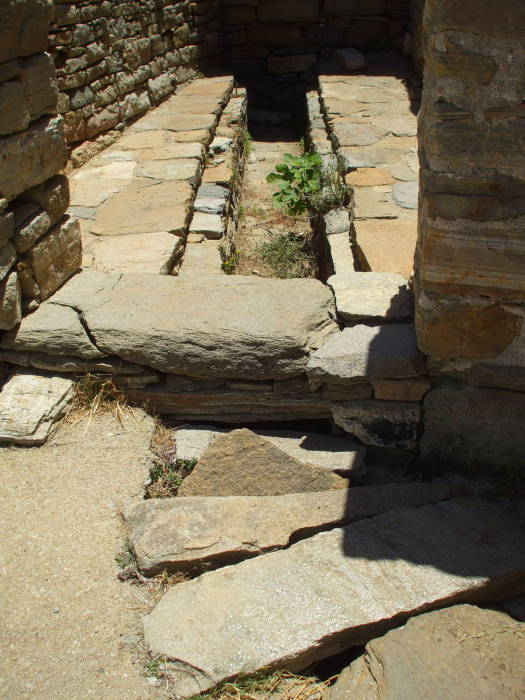
Other pictures of plumbing from the time of the sacred use of Delos include the large latrine of the House of the Trident, seen here, the latrine of the Lake House, an underground sewer channel, buried beneath one of the main streets, and a system of aquaducts and cisterns used to collect the rare drinking water on the arid island.
See the dedicated Delos page for those further details.
625 BCE — 1000 CE
Magna Graecia
Magna Graecia was the Latin for "Greater Greece". The people who settled it would have called it Μεγαλη Ελλας or Megale Hellas, "Greater Greece".
Magna Graecia Toilets625 BCE — 1000 CE
Greek settlers colonized southern Italy and Sicily in the 8th Century BCE. It was absorbed into the Roman Republic after the Pyrrhic War (280-275 BCE). A major city was Ποσειδονια, or Poseidonia, called Paestum in classical Roman times and today. It's south of Salerno, an easy day trip from the Amalfitani coast.
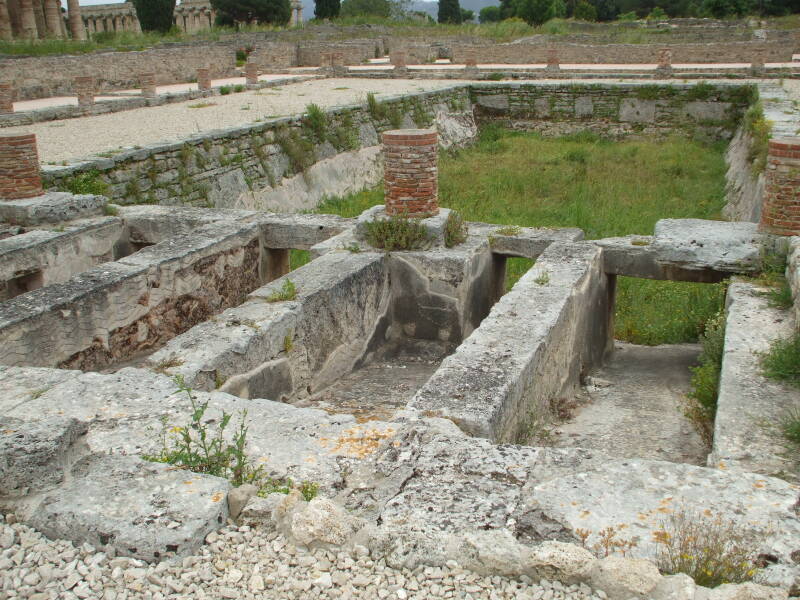
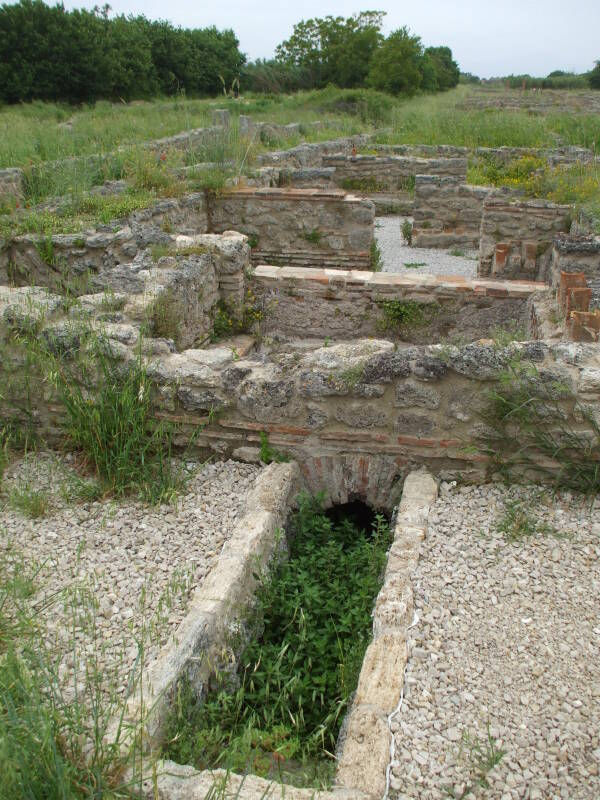
Above is the Temple of Athena and one of the public pools or baths. The next picture is a drain from either a smaller bath or a public latrine.
Many more pictures and historical details are included on the dedicated Paestum page.
550 BCE — 300 CE
Asclepeion of Kos
The Ancient Greek Medical School and its Plumbing
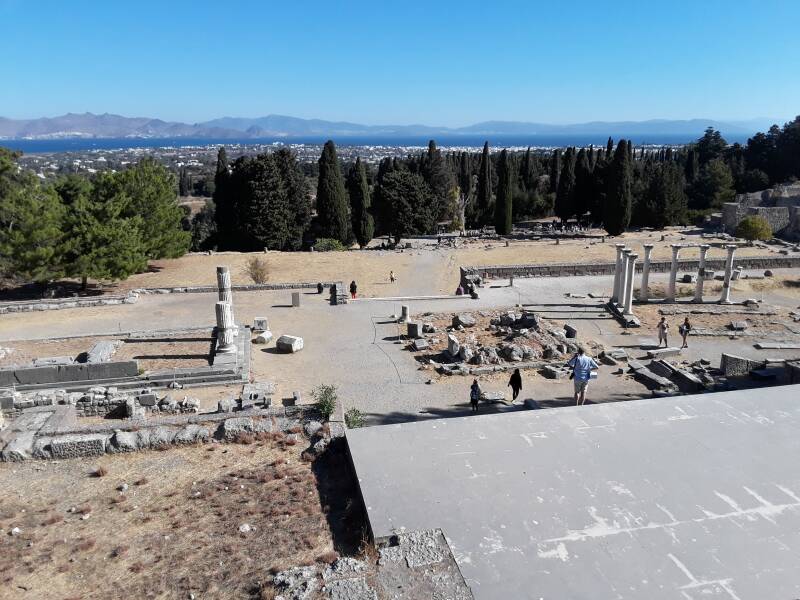
One of the main things to see on the Greek island of Kos, the main attraction in my opinion, is the Asclepion. This is an ancient medical school and clinic associated with Hippocrates, Galen, and others. We're at an upper level looking out over the site with Kos town in the distance, then the strait and Bodrum, Turkey, beyond that. Much closer, beneath the trees to the left, is where the latrines were located. To the right are the large baths of the later Roman era, with many remaining pipes and drains.
Ancient Kos
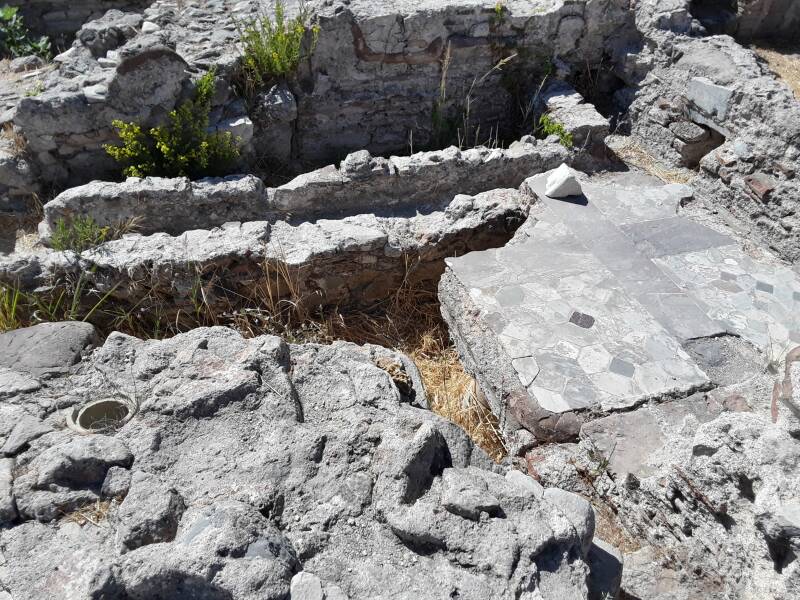
The Western Excavation Site in Kos town has ruins from Hellenistic times into Roman times. Here are remains of a public toilet.
509 — 27 BCE
Roman Republic
The city block of Rome between Largo di Torre Argentina and Via Florida on the north and south, respectively, and Via di Torre Argentina and Via San Nicola da' Cesarini on the west and east, respectively, contains a number of plumbing-related Roman ruins.
The Statio Aquarum or the Office of the Department of Water Distribution are located here.
Also, the portico of Pompey, formally known as Gnaeus Pompeius Magnus, was located here. It served as the Roman Senate house. The Senate met there, and it was where Julius Caesar was assassinated on 15 March 44 BCE.
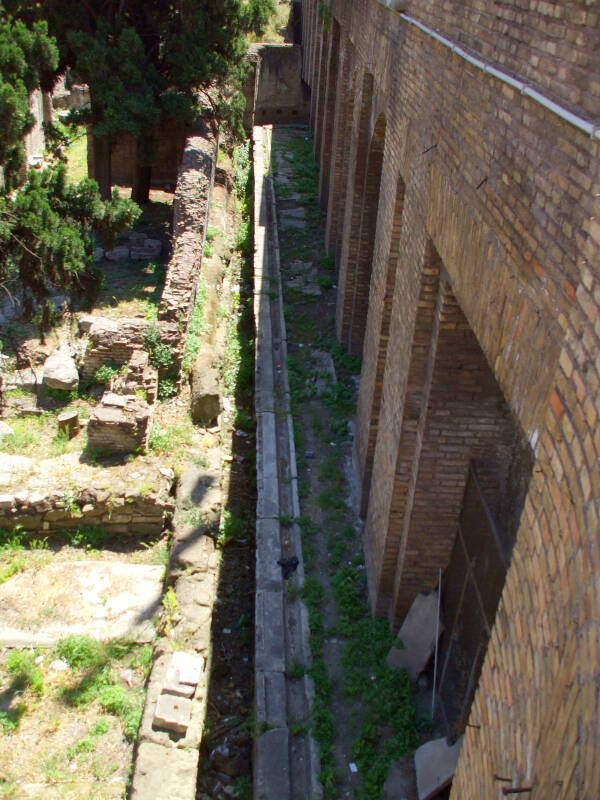
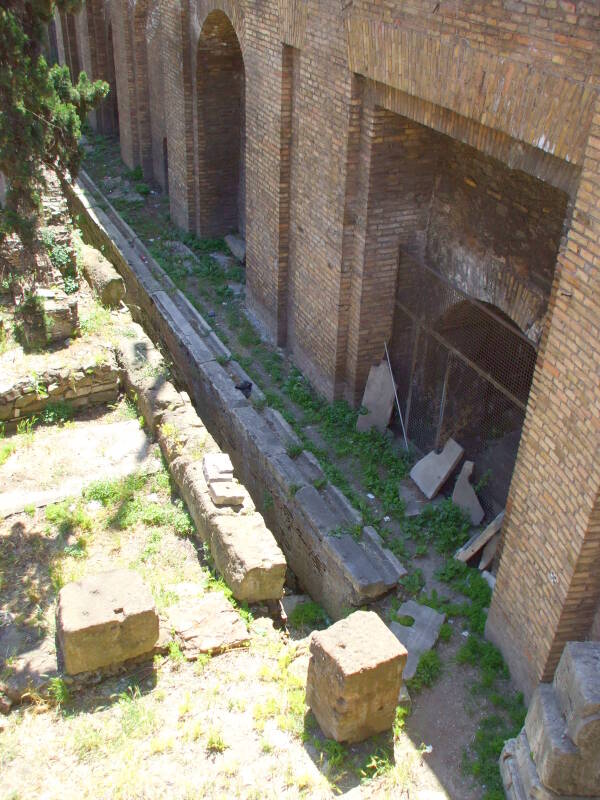
A large public latrine is in the northwest corner of this excavated block. This would have been the toilet used when the Roman Senate took a bathroom break, since the Senate met in the building adjacent to the south side of this large latrine.
Roman Republic Toilets509 — 27 BCE
A long row of seats, now missing, would have been directly over the large channel. Users would have been seated facing toward our right in this view, or toward the more recent brick wall, so they could bend forward and dip water from the shallow channel running past their feet.
More pictures and historical details are on the dedicated Roman Republic era toilet page.
292 BCE — 1000s CE
Biblical, New Testament
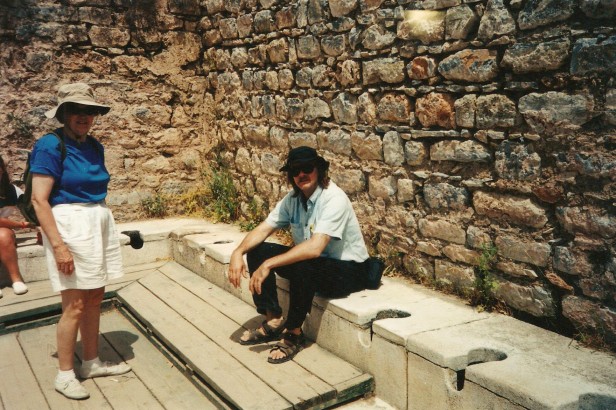
New Testament Biblical toilets in my collection include the famous public latrine at Ephesus, seen here. A settlement was founded in that area in the 10th Century BCE, but it was relocated to its final location in 292 BCE. Ephesus became the principal city of Asia Minor, so this public latrine was quite large.
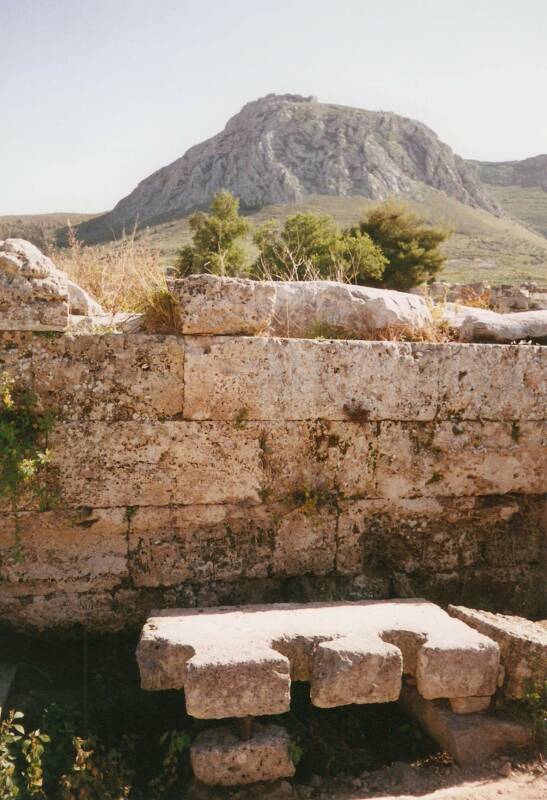
These similar marble public toilets are next to the main processional way from the harbor gate in Corinthos, Greece. These date from when the Apostle Paul was visiting Corinthos, trying to turn people away from the mountaintop debauchery at the Temple of Aphrodite, visible on the mountaintop in the distance.
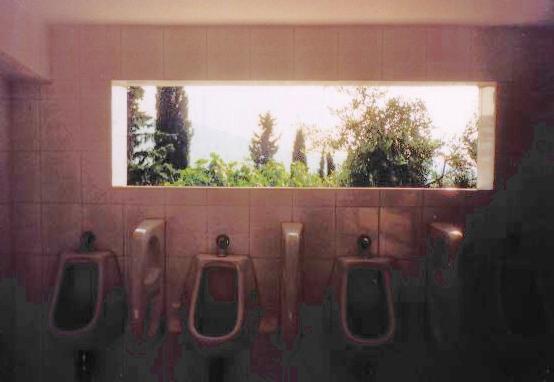
These surprisingly scenic urinals are at Maryemana, on a mountain above Ephesus.
Other New Testament era toilet pictures on the dedicated page include more from both Ephesus and Corinthos, and pictures of the public latrines at Hierapolis in Asia Minor, now Pamukkale, Turkey.
Toilets of Christian Sites292 BCE — 1000s CE
28 BCE — 300s CE
Roman Empire (Gaul)
Rome founded the colony of Nemausus in southern Gaul before 28 BCE. We now call it Nîmes, in southern France.
The Romans built a 50-kilometer aqueduct to bring some 40 million liters of water to the city every day. This required an aqueduct bridge to carry the water over the Gardon river. This bridge, now known as the Pont du Gard, was 360 meters long and almost 50 meters above the river's mean water level.
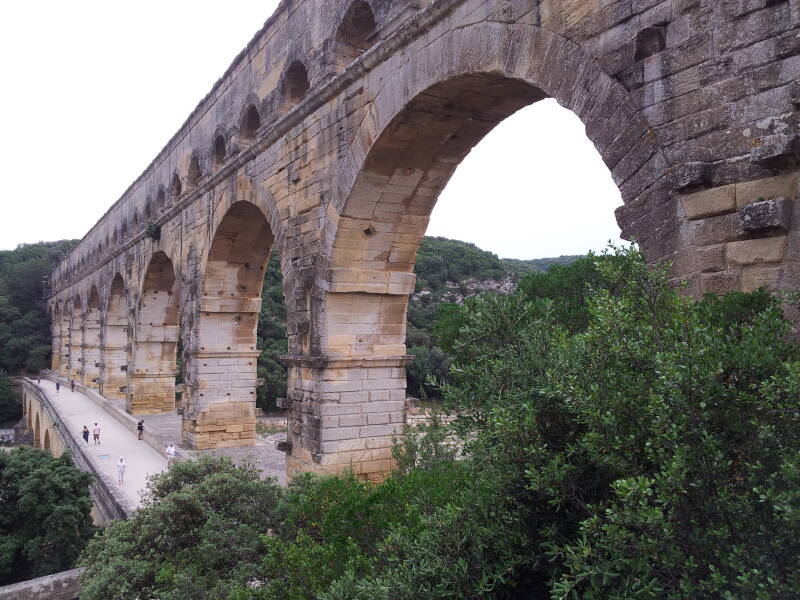
Pont du Gard is now the 5th most visited site in France. The nearby museum displays Roman plumbing technology, including public latrines. It also shows how the Romans carried out various hydraulic engineering projects.
25 BCE — 285 CE
Berber-Roman Volubilis
Toilets of Volubilis Visiting
Volubilis
Volubilis was founded by the Berber people in northwestern Africa, in the northern part of today's Morocco. It was the capital of Juba II, who ruled the Kingdom of Mauretania. His first wife was the daughter of Cleopatra and Marc Antony, and Rome had installed Juba as their client-king.
Volubilis was at the extreme southwestern fringe of the Roman Empire. Much of the two Roman provinces of Mauretania Caesariensis, in today's northern Algeria, and Mauretania Tingitana, in today's northern Morocco, were reconquered by Berber tribes after Rome's Imperial Crisis of the Third Century. Christianity had spread to parts of Mauretania, but it was mostly confined to port cities in the east. The interior maintained the Romano-Berber religion, which had been influenced by ancient Egyptian, Punic, and Phoenician beliefs.
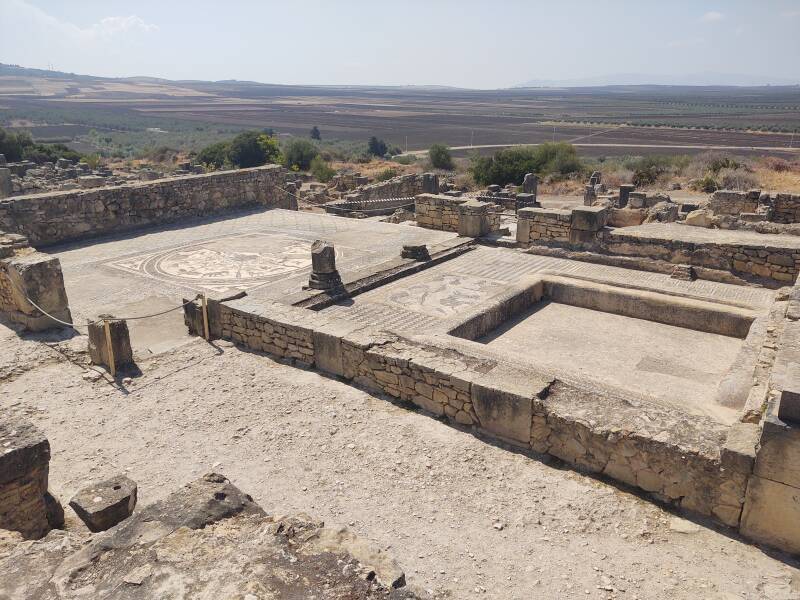
Here are some plumbing features from the last century before Volubilis collapsed. First, one of the several elaborate baths in the city:
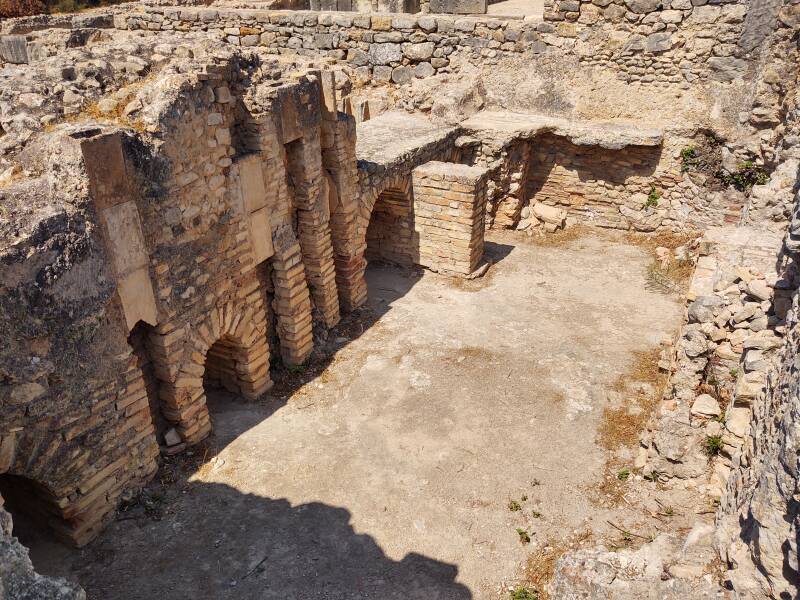
This multi-person latrine was in the home of a wealthy family. Seats lined the far and right-hand wall. Close to us is the rectangular stone basin that held water for rinsing the tersorium or xylospongium, the sponge on a stick used for cleaning yourself.
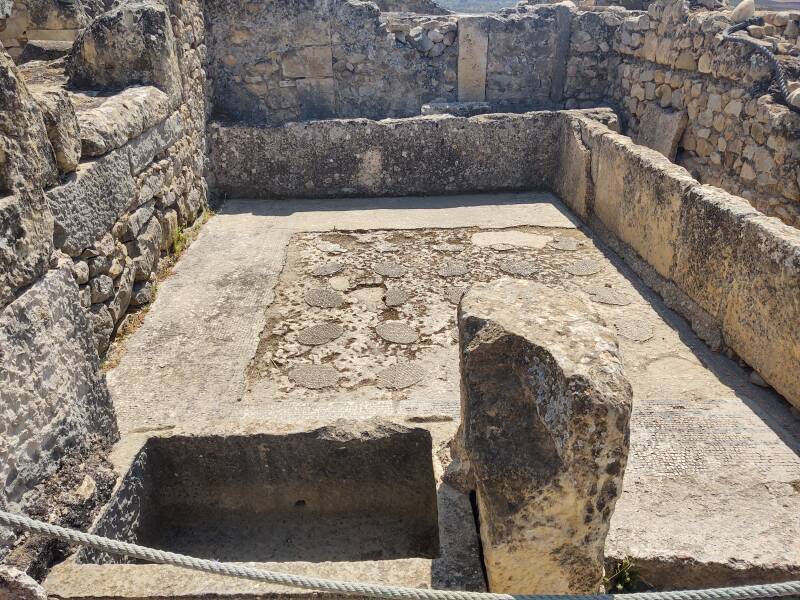
The same home is known as the House of Orpheus. We don't know the name of the wealthy family who lived here, the name comes from the mosaic depicting that figure in the triclinum, the room at left that would have had benches around three sides. Guests could recline there and admire the mosaic, and also the large pool of water in the adjacent room.
62 CE
Roman (Oplontis)
Roman Emperor Nero had a luxurious villa in the town of Oplontis, the Villa Poppaea. Unfortunately for Nero, his villa was close to Pompeii, and more significantly, very close to Vesuvius.
Nero was born 15 December 37 CE, and ruled from 13 October 54 until his death by suicide on 9 June 68. He had accomplished quite a bit by then, but mentioning that is much like pointing out that Adolf Hitler liked dogs.
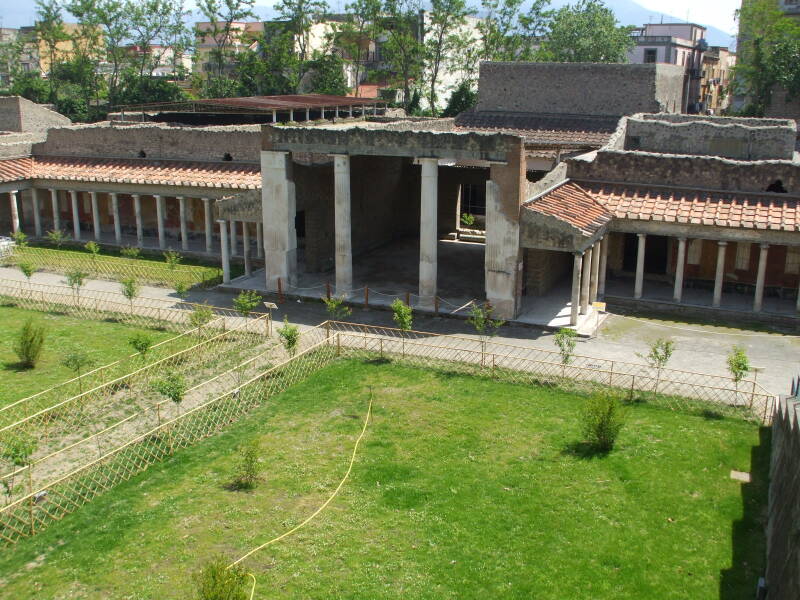
In 53, Nero married his stepsister Claudia Octavia. Then, in 58, Nero began an affair with Poppaea Sabina, the wife of his friend (and future Emperor) Otho. He then ordered the murder of his mother in 59 because it did not seem politically feasible to divorce his stepsister and marry his friend's wife while his mother was alive.
62 CE
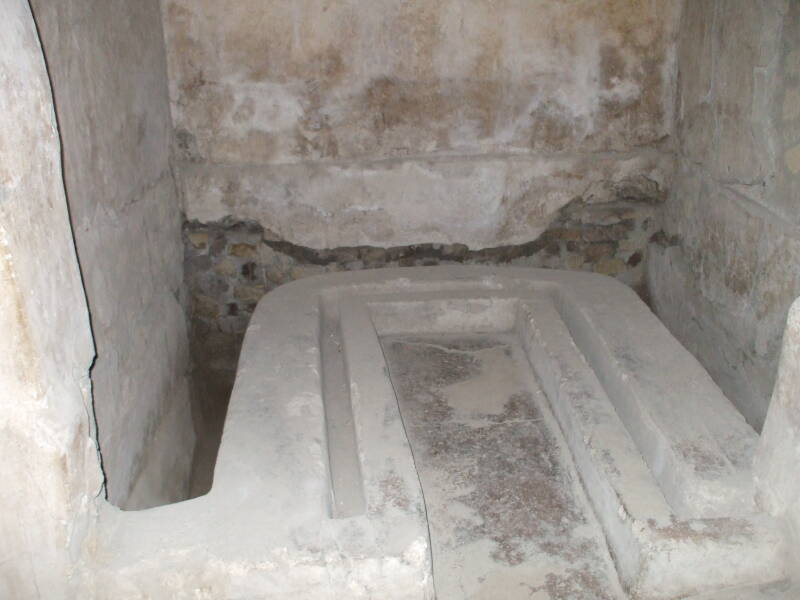
After Nero married Poppaea Sabina in 59, she used this as her main residence when she was not in Rome. And here we can see the large multi-person latrine inside the villa.
Click here for many more pictures and details about Nero's villa, his career, and this latrine.
79 CE
Roman (Pompeii)
Pompeii was a prosperous Roman city until it was buried in volcanic ash in the eruption of Vesuvius in August of the year 79 CE.
Pompeii Toilets79 CE
One popular sight in the excavated city is the Lupenaro or home of the "she-wolves", the famous Pompeii brothel.
Here you see the brothel toilet. It's a basic one-hole frame design built of stone. A chamber pot would be placed below the hole, to be dumped into the sewer immediately outside after use.
So, this is an indoor toilet but not indoor plumbing.

One of Pompeii's main products was processed wool. Wool must be fulled, which means cleaned or scoured. The wool fulling process in Roman used human urine. Here we see a wool fulling tank, once filled with urine and used to clean the newly purchased wool.

79 CE
Other pictures on the Pompeii page show further details of Pompeii, such as the plaster casts of the bodies of victims, more details of the city and the brothel, Pompeii's systems of sewage and drainage, the large city baths, and more pictures of the urine-based wool fulling operation.
122 — 700 CE
Roman Empire (Britannia)
Hadrian's Wall was built across the narrowest part of Britain just south of the Pictish lands starting in 122 CE, during the rule of the Emperor Hadrian.
Imperial Roman Toilets122 — 700 CE
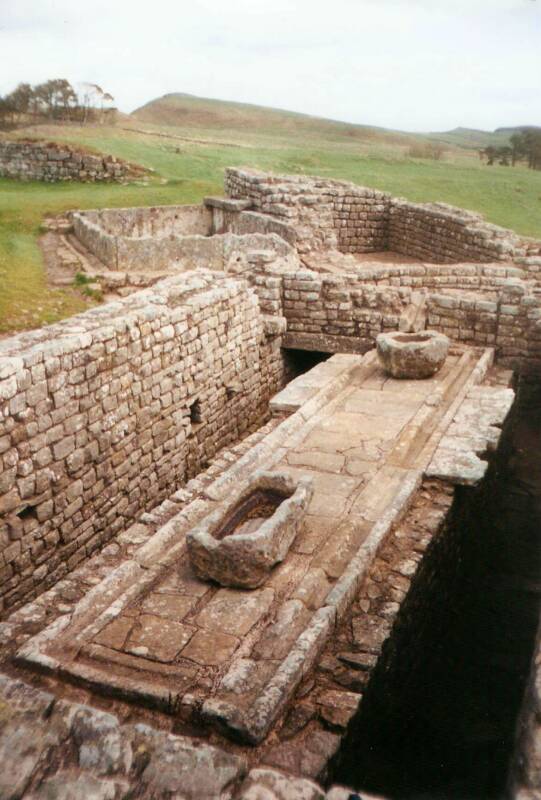
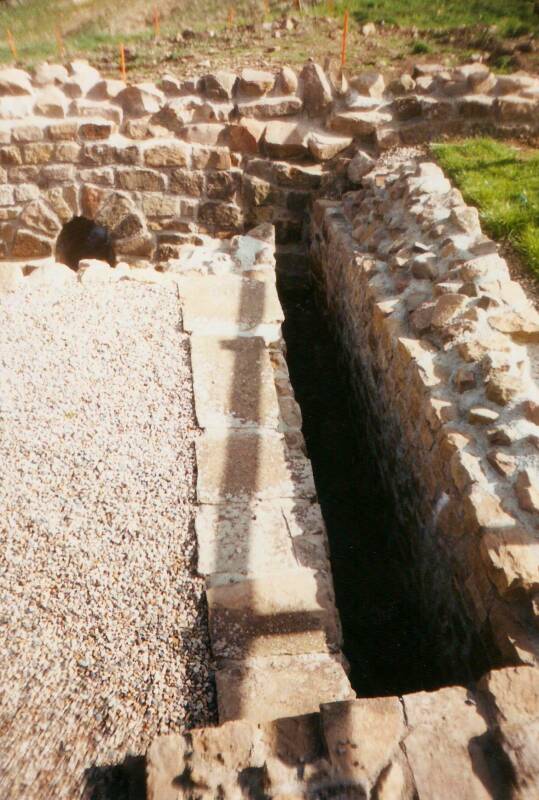
The first picture here shows the Imperial Roman toilets at Vercovicium Fort, a part of Hadrian's Wall.
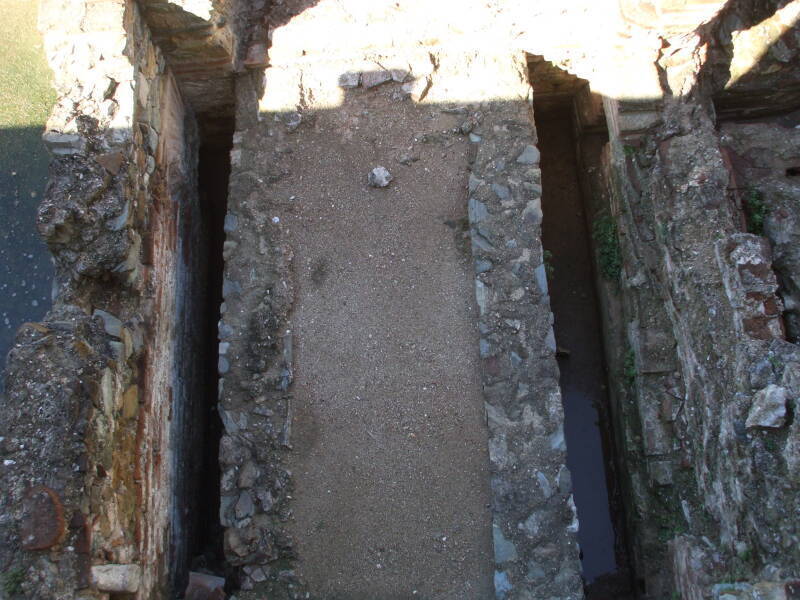
The Roman toilets in the second picture are at the military garrison at Vindolanda Fort, near Hadrian's Wall and quite close to Vercovicium Fort.
305 — 311 CE
Late Roman (Thessaloniki)
Galerius, formally and fully known as Gaius Galerius Valerius Maximianus, was born around 260 CE. He was Roman Emperor from 305 to 311.
Late Roman Toilets305 — 311 CE
Galerius based himself in Thessaloniki because, let's face it, Rome was pretty well gone by the early 300s. Constantinople was where you found culture. Since there was an Augustus already ruling in Constantinople, and Rome was a wreck, Galerius had a base in Thessaloniki where several Galerian monuments survive.
One of these is the excavated site of his palace, on today's Plateia Navarinou. Of course it had latrines, and of course I photographed them.
909 — 1171
Fatimid
Fatimid Toilets909 — 1171
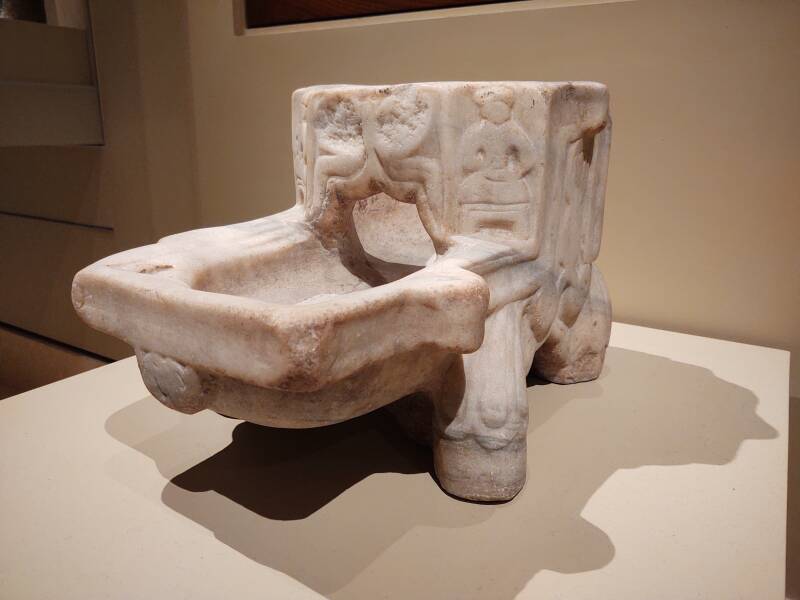
This fine marble kilga or water jar stand held a babb, a large unglazed earthenware jar. Water was filtered as it seeped through the bottom of the jar, and it collected in the basin at bottom.
This kilga was produced sometime in the 11th through the first half of the 12th century in either Egypt or Syria.
960s — 1539
Arthurian
In 1191 the Glastonbury Abbey in southwestern England was in financial trouble. The abbot directed the monks to dig in a particular spot in the cemetery, where they found a large oak casket holding a man and woman. Obviously this was Arthur and Guinevere! Well, there was a lead cross enscribed in Latin, reading something like Here lies Arturus, king of the Britons. So they were moved to a new tomb in what was then a fairly new cathedral. And so today you can stand in one spot and see two tombs of Arthur and Guinevere.
Arthurian Toilets960s — 1539
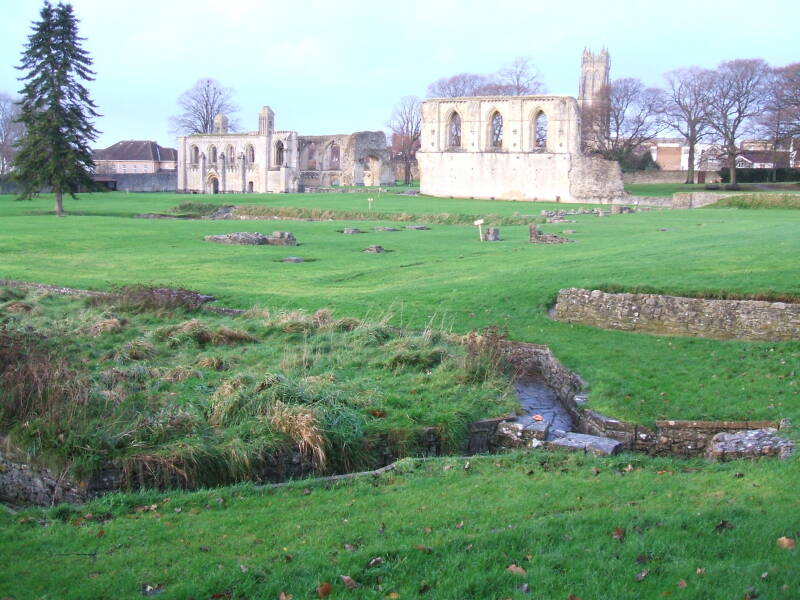
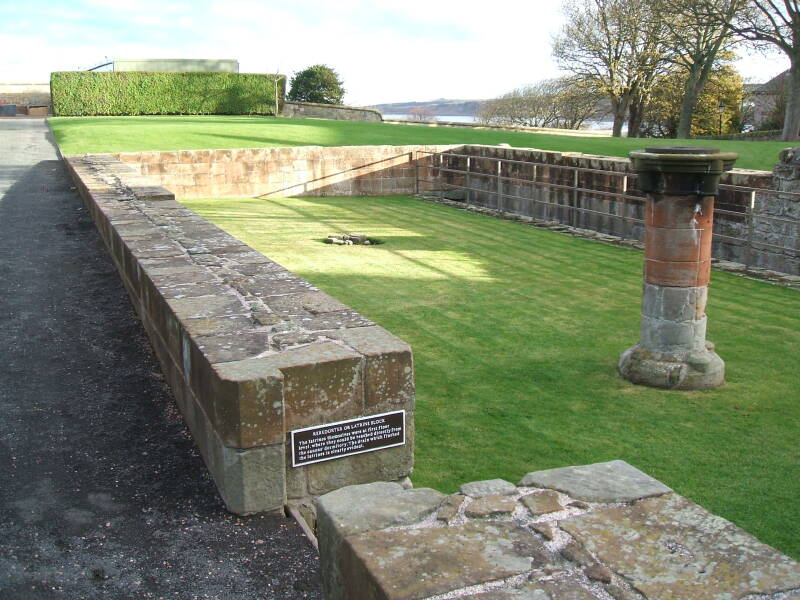
The abbey ruins include a large plumbing contraption labeled REREDORTER. This obscure term specifically means the latrine associated with a monastic establishment, which is usually located behind the dorter or sleeping quarters.
The Arthurian Toilets page has further details and more pictures of the plumbing ruins of Glastonbury.
1140 — 1518
Medieval Scotland
Medieval Scottish
Ecclesiastical Toilets
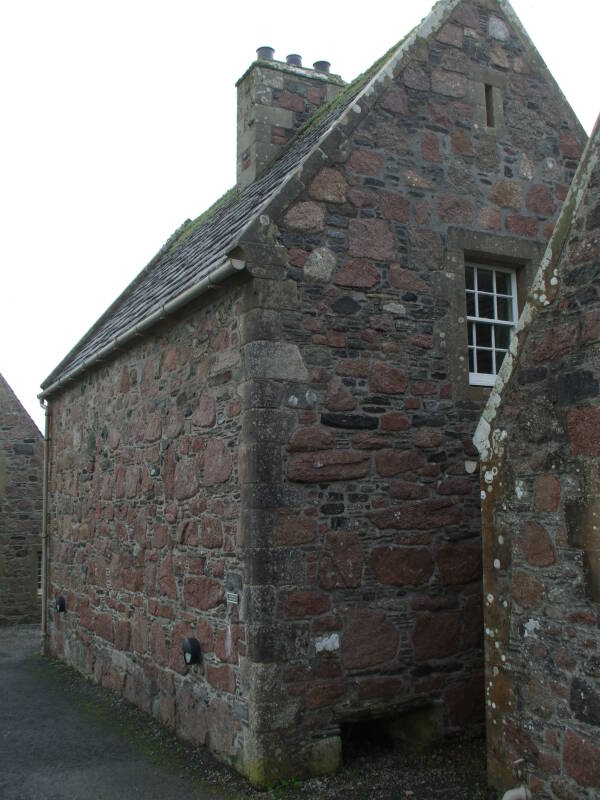
Monastic communities called their latrines reredorters. Here is the reredorter at the Saint Andrew Cathedral Priory, a priory of Augustinian canons. Construction on the cathedral began in 1158.
Off the west coast of Scotland, in the Inner Hebrides, the Iona Abbey was built starting in 1203. However, the monastery itself dates back to the arrival in the year 563 of Colm Cille, later known as Saint Columba, with 12 companions. This is the reredorter of the abbey.
The dedicated Medieval Scottish Ecclesiastical page has further pictures and details on the reredorters and other plumbing features of both Saint Andrews and the Iona Abbey.
1309 — 1415
Avignon Papacy
How many Roman Catholic Popes are there?
In the early 14th century, there were up to three! The Roman Papacy had relocated in 1309 to Avignon, in Provence, today part of southeastern France. After six more ruling Popes, the 7th of the Avignon Papacy decided to move the Papal court back to Rome. Things became very messy when he died shortly afterward..
At first there were two competing Popes, one newly elected in Rome and the other newly elected in Avignon. Then a group of church leaders met in Pisa, concluding for some reason that if they would only elect another new Pope, then the two competing ones would both step down.
No. The office of Pope brought enormous wealth and power. The result was three simultaneous competing Popes.
Meanwhile, where did the Avignon Popes poop?
Into a chamber pot held within a close stool maintained by the Groom of the Pope's Stool, the same as with all the other European royalty.
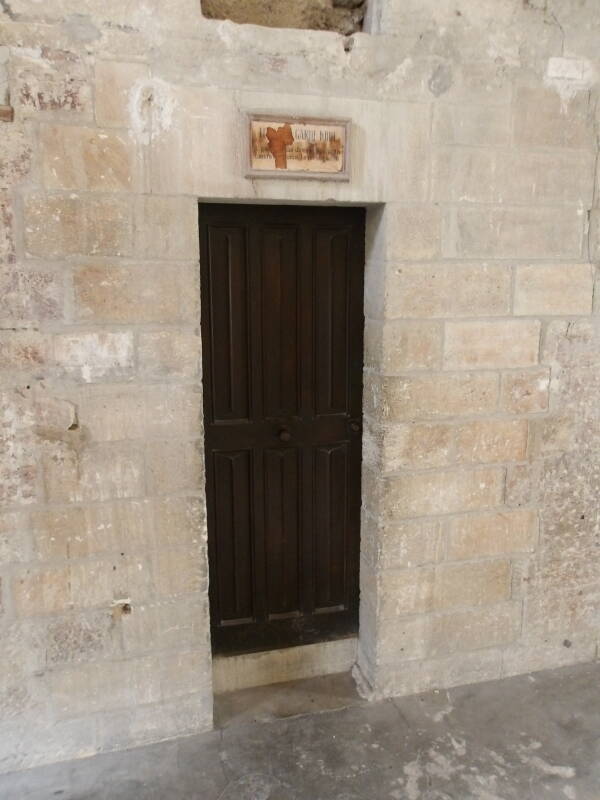
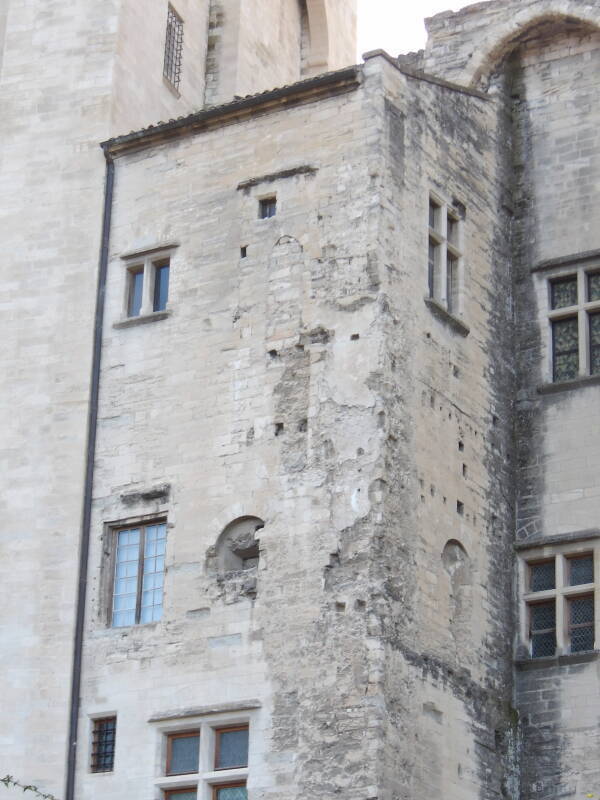
Garde-Robe of the Avignon PapacyBut what about the Papal court members, and all the guests of the enormous feasts thrown by the wealthy Pope?
They would have used a garde-robe, a privy attached to the outer wall of a castle or palace. It isn't highlighted on the official tour, but I spotted it.
1402 — 1921
Crusader
Tamerlane invaded Anatolia in 1402, reducing the control of the Ottoman Empire over south-western Anatolia. The Knights Hospitalier, also known as the Knights of Saint John of Jerusalem, built the Castle of Saint Peter at Halicarnassus, Asia Minor (now Bodrum, Turkey). These are the toilets.
The castle construction started in 1402. Various extensions and reconstructions continued for at least a century.
The castle fell to Suleiman the Magnificent in 1522. It was used as a military base by the Turks through the 1800s. In 1895 it was converted into a prison.
Crusader Toilets1402 — 1921
It was an Italian garrison 1917-1921, but the Italians withdrew when Atatürk came to power.
See the Crusader toilet page for more details on the Crusaders, the Turks, and the toilets.
1465 — 1853
Imperial Ottoman
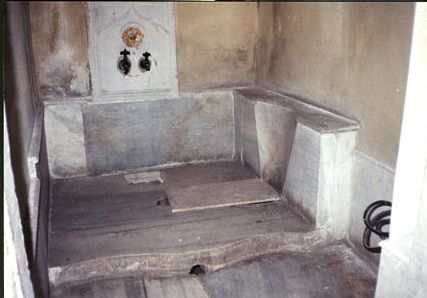
This is the Imperial Ottoman Throne, at least in some sense.
This is the toilet of the Sultan of the Ottoman Empire, the ruler of all the Middle East, northern Africa, and south-east Europe. This toilet is in the harem, the private quarters of the sultan, in Topkapı Palace in İstanbul, Turkey, the official and primary residence of the Ottoman Sultans from 1465 through 1853.
Imperial Ottoman Toilets1465 — 1853
There's a board over the hole, but you can still appreciate the fine marble and Sultan-level craftsmanship.
The Imperial Ottoman Turkish toilet page has further details on this toilet, and pictures and details of another mid to late Ottoman toilet design from Bodrum.
1596-1855
England
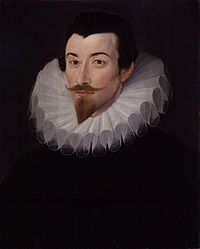
Sir John Harington is generally credited with (re-)inventing the flush toilet in England (no, Thomas Crapper had nothing to do with it).
English FlushToilet Development
1596 — 1855
Harington wrote a satirical booklet ostensibly describing how to build a cleaner and less odorous toilet like the new one at his house, although it was a fairly overt allegory criticizing the court of Queen Elizabeth I, especially her favorite courtier.
See the dedicated page for the whole story.
1600
England
Shakespeare-EraEnglish Toilets
1600
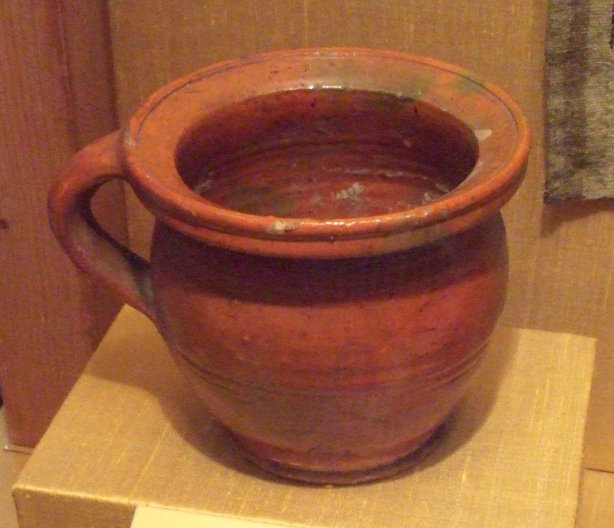
This Shakespearean chamber pot is not The Bard's Own Thunder Mug, but it is a typical English chamber pot from around 1600. This one was brought from England to the English colony at Jamestown, Virginia.
See the dedicated page for further details on this chamber pot.
1750 — 1759
Pre-Revolution France
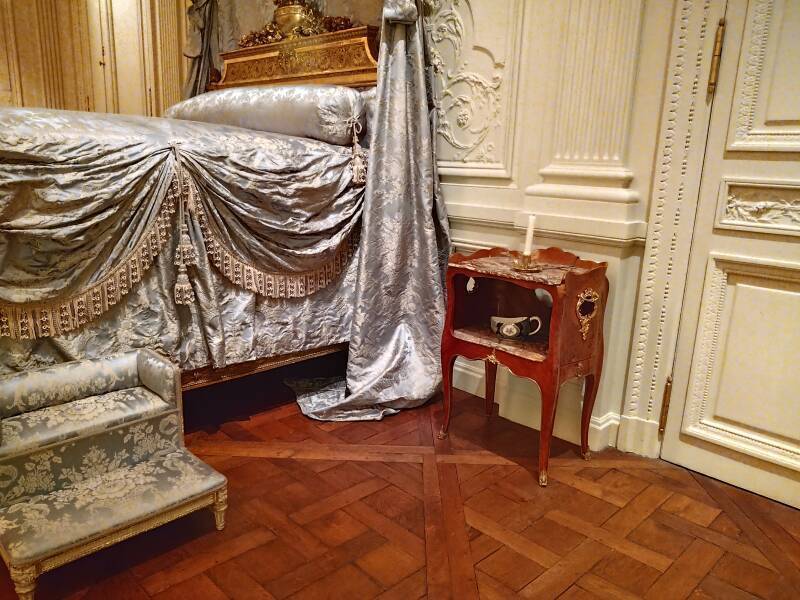
The nobility in pre-Revolution France had elegant homes in Paris, but they had to use chamber pots as indoor plumbing was still a hundred years in the future.
Pre-Revolution France1750 — 1759
This soft-paste porcelain chamber pot from the Sèvres manufacturing plant is an example of what European nobility used in place of toilets. The Sèvres porcelain factory had been founded in 1738 by King Louis XV and Madame de Pompadour, his official chief mistress.
This example is in the collection of the Metropolitain Museum of Art in New York.
The dedicated page has more pictures and details on chamber pots, Sèvres porcelain, the French hôtel peculier, some specific noble homes, and a club of hash-eaters made up of prominent literary and artistic figures.
1750 — 1790
American Revolution
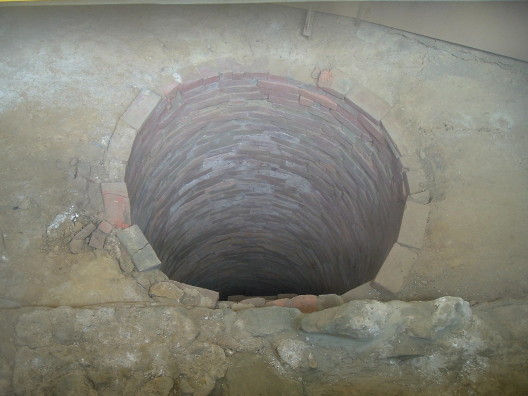
Benjamin Franklin's privy pit can be seen at the site of his home in Philadelphia, Pennsylvania. A nearby sign says:
This brick-lined, circular "necessary" (privy) pit was probably built when Franklin expanded his house in 1786-1787. A stone drain connecting to a vertical brick pipe conveyed waste into the pit either from Franklin's "water closet", "bathing room", or "run-off" from the sunken areaway outside the cellar kitchen.
American Revolution Toilets1750 — 1790
The dedicated page has more pictures and details of this privy pit, a second privy pit, and a nearby well.
1830 — 1835
19th Century America
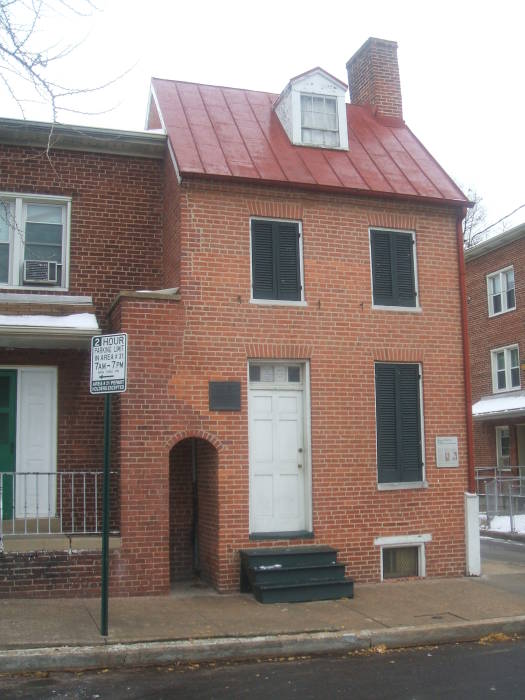
Edgar Allan Poe moved to Amity Street in West Baltimore in 1832. The home was outside the city then. Now it's in the middle of a pretty awful urban setting. He won an 1833 literary contest for his story MS. Found In A Bottle. In 1835, he married his young cousin Virginia.
Edgar and Virginia Poe, with mother-in-law in tow, later moved to New York. In October, 1849, Poe was passing through Baltimore. On the night of the 3rd, he was found on the streets delirious and "in great distress, and in need of immediate assistance." He was taken to a hospital, where he died on the morning of the 7th without becoming coherent enough to explain how he had gotten into his dire state or why he was wearing someone else's clothes. Delirium tremens, heart disease, epilepsy, syphilis, meningitis, cholera, and rabies have all been blamed.
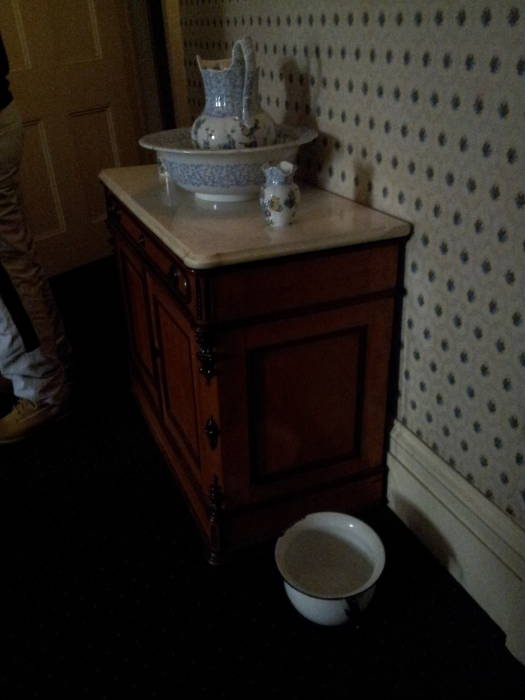
American homes did not have indoor plumbing in the 1830s. The Poes would have had chamber pots in the bedrooms and possibly a privy out back. But given the dire financial situation of the Poes, their privy may not have been much.
1830 — 1835
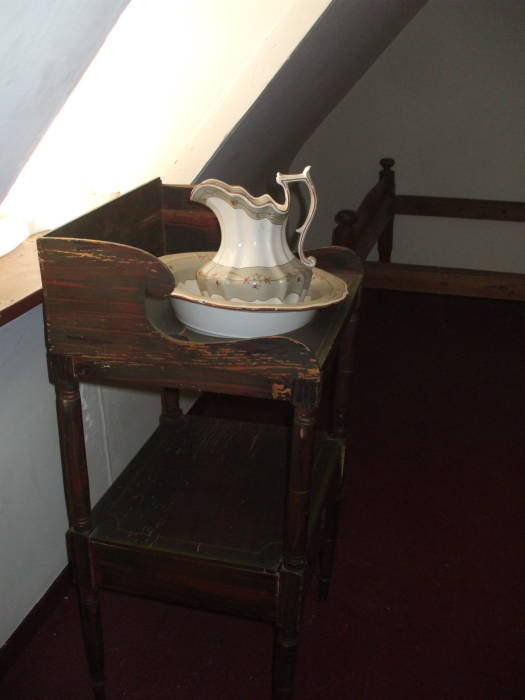
Here you see a specially made wash stand holding a ceramic bowl and pitcher in the small bedroom on the top floor. This was the state of the art of indoor "plumbing" in America in the 1840s.
The detailed Edgar Allan Poe page has more details on Poe's life and their home in Baltimore.
1848 — 1872
Mid 19-Century America
By the third quarter of the 19th century, public utilities including potable water, liquid waste disposal, and gas for lighting and heating was beginning to become available.
Theodore Roosevelt'sChamber Pot
1848 — 1872
Theodore Roosevelt was born to a financially successful family living in a nice brownstone on East 20th Street in Manhattan.
Natural gas was distributed through pipelines in that part of the city, and the Roosevelt home used gas for lighting.
The Croton Aqueduct was built between 1837 and 1842, carrying water from the Croton River in Westchester County to reservoirs in Manhattan. One reservoir was at 42nd Street and Fifth Avenue, the current location of the main branch of the New York Public Library. It held 20 million US gallons or 76,000 cubic meters of water, and was put in service in 1842.
But when Theodore was born in 1848, water distribution and sewage collection systems did not extend as far south as 20th street. They collected water from a well and carried it into the house, and then carried their waste back out.
The dedicated page has more pictures and details on the Roosevelt home, including this water pitcher and chamber pot. Plus, more on the home itself and the influential family that lived there.
1854
Victorian London
Victorian England Sanitation1854
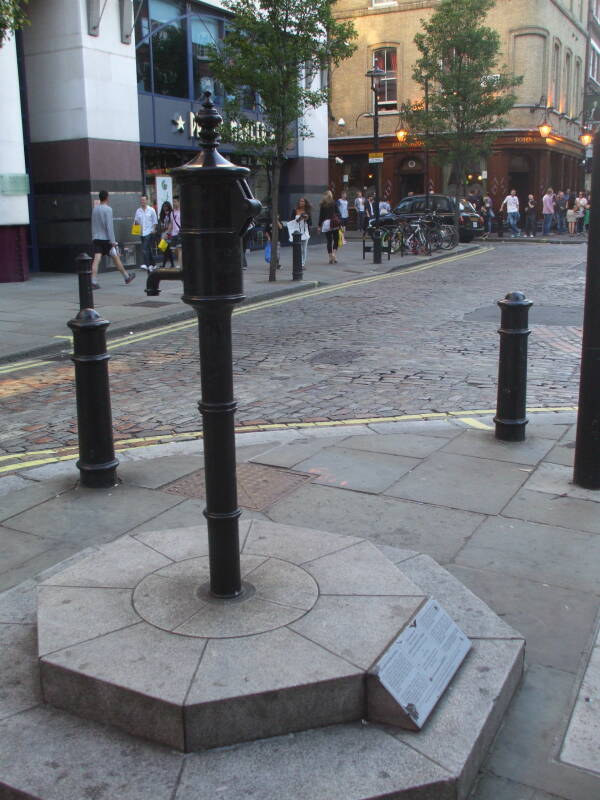
See the detailed Cholera Pump page for further details on cholera, this outbreak, and Snow's work and legacy.
A cholera outbreak in 1854 killed 10,738 people in London. It was centered on the Soho area.
Doctor John Snow analyzed the available information and determined that the main agent spreading cholera was a public water pump on Broad Street. The spring below the pump had been contaminated by sewage.
Snow didn't know what the contaminant was, but he found that the common attribute of victims was the use of water from that pump. Snow's analysis was one of the first examples of epidemiology. Despite objections, he convinced the government officials to remove the pump's handle. This stopped that outbreak, but it took many more years before there was wide belief in contaminated water as the cause. "Miasma" or "bad air" was the preferred explanation.
1880 — 1900
19th Century Scotland
19th Century Scottish Toilets
1880 — 1900
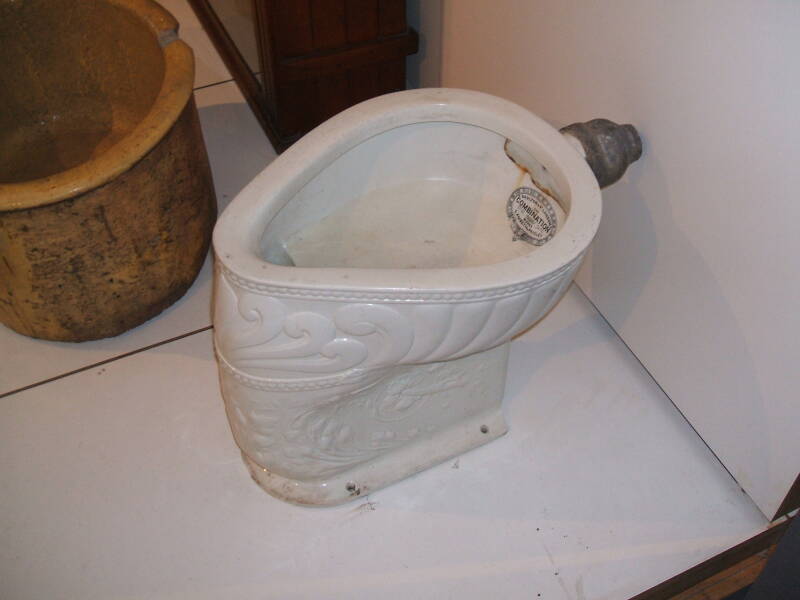
This unit is by Doulton and Company, labeled inside the bowl as "The Combination". The dedicated page has further examples of late 19th Century Scottish plumbing.
It is not just random chance that Star Trek featured a Scotsman as an engineer — Scotland has an amazing history of engineering. And of course this includes their toilets!
The national museum in Edinburgh has a great collection of Scottish engineering and manufacturing, including some Scottish toilets from the late 1800s.
1849 — 1929
Barbary Coast, San Francisco
The Barbary Coast was a notorious red-light district in San Francisco. It was created during the 1849 California Gold Rush when tens of thousands of miners were flooding into the city. There was very little law enforcement, really very little city government of any form, and so crime flourished.
Barbary Coast1849 — 1929
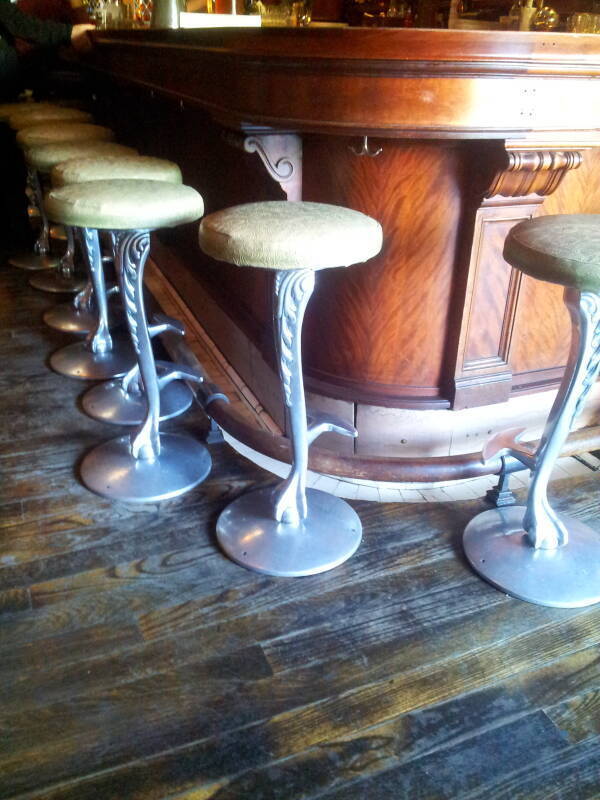
The second-oldest saloon still in operation in San Francisco was built as the Andromeda Saloon in 1907, just one year after the devastating magnitude 7.8 earthquake and following multi-day fires.
It was renamed as the Albatross Saloon in 1977.
Then in the mid 1980s when there were only three brew pubs operating in the U.S., it became the San Francisco Brewing Company.
In 2009–2010 it was remodeled and re-opened as the Comstock Saloon.
The latest renovation uncovered and restored some of the original features that had long been hidden. One of these is the ceramic urinal trough running the length of the bar.
Visit the dedicated page for more pictures and history of this unusual plumbing fixture.
1910 — 1943
Fascists and Laxatives
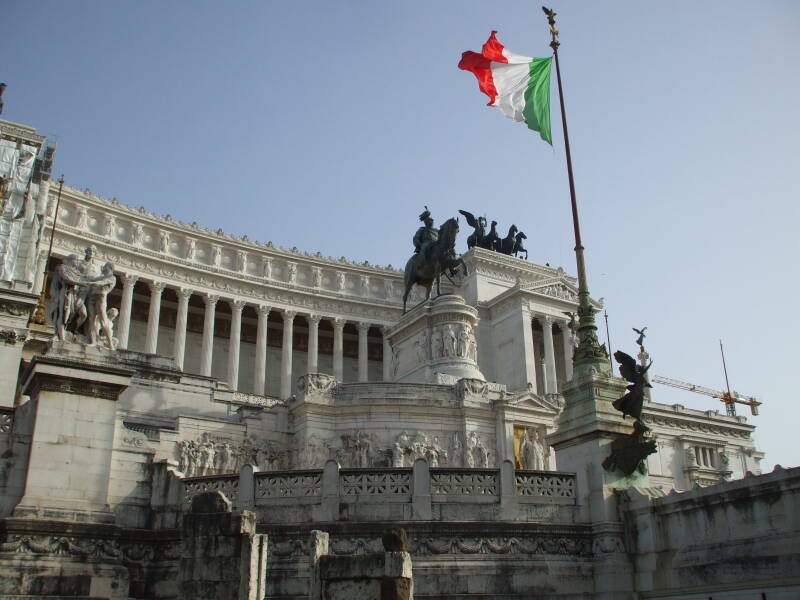
Benito Mussolini's Blackshirt thugs used the powerful laxative castor oil as a weapon of torture and coercion, as punishment and threat.
He didn't devise this on his own. Like much of Italian Fascism, including the Roman salute, the balcony address in which the dictator harangues the crowd at length, and the appropriation of religious symbols for large public secular rituals, he also got the idea for laxative punishment from Gabriele D'Annunzio, a poet, writer, journalist and playwright turned anarcho-fascist.
1910 — 1943
The page dedicated to Fascist coercive use of laxatives has all the details.
1900 — 1950
Early-Mid 20th Century America
Early-Mid 20th CenturyAmerican Toilets
1900 — 1950
Although it's a new country, the United States of America still has a lot of active plumbing from 50 to 100 years ago.
The early 20th century brought marble partition walls, geometric patterns of small floor tiles, and these large freestanding urinals.
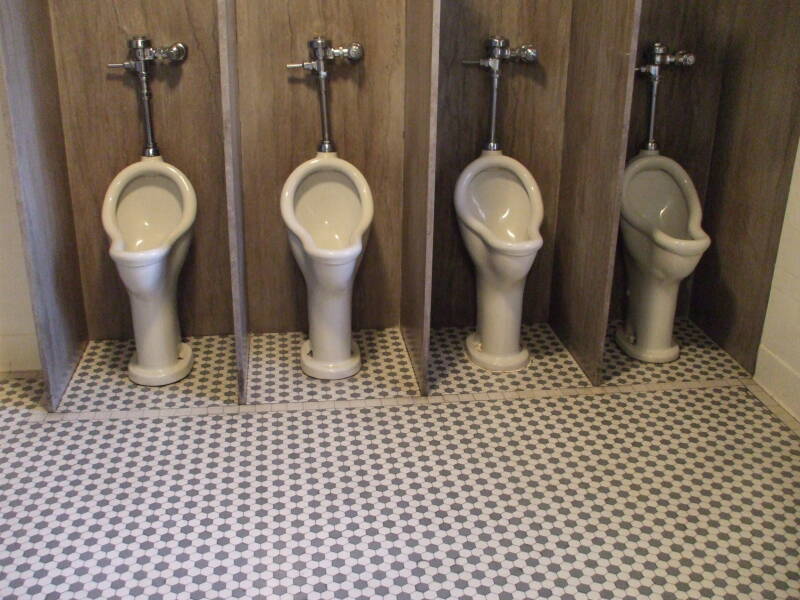
The 1950s led into the 1960s with ceramic in various shades of avocado and gold.
The dedicated page has further examples of early-mid 20th Century American plumbing, including that found in Theodore Roosevelt's childhood home in New York, Woodrow Wilson's home in Washington, D.C., Depression-era public toilets, vintage mid-century government toilets, and the personal facilities of Dwight Eisenhower.