
Toilets in Motion
Toilets on Trains, Subways, Buses, Ships, Submarines, Aircraft, and Spacecraft
Some of the more unusual toilets in the world are those on moving vehicles. I have pictures of toilets on trains, in subway stations, on inter-city buses, and on board ships, and airplanes. I even have pictures of toilets on spacecraft, as seen in museums. Do you know why ships' toilets are called heads? Do you know what a drop chute toilet is? Do you know how to go to the bathroom in space? Find out! Click on any of the pictures or links to be taken to pages with many more pictures showing that mode of toilet transportation in detail.
Trains
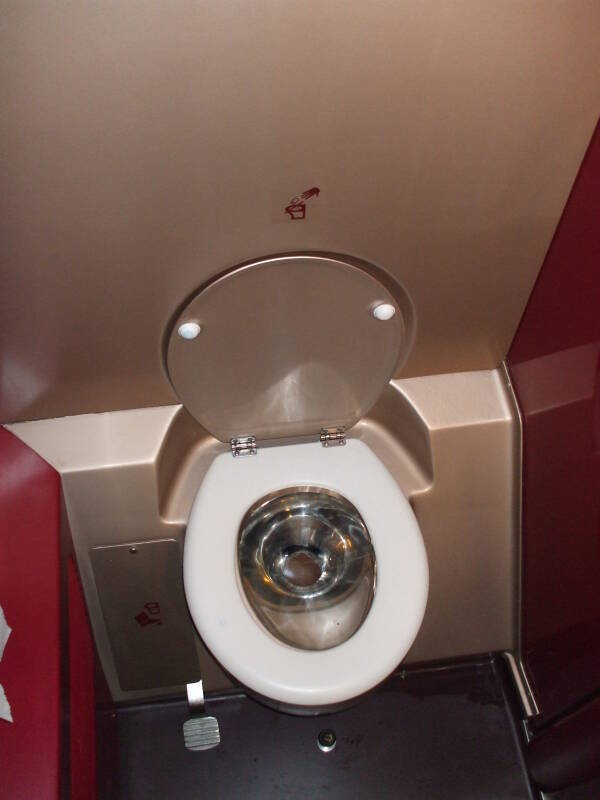
High-end trains have high-end toilets. This is a toilet on board the Belgian Thalys train running at 300 kilometers per hour between Brussels and Paris.
Of course, not all train toilets are nice...
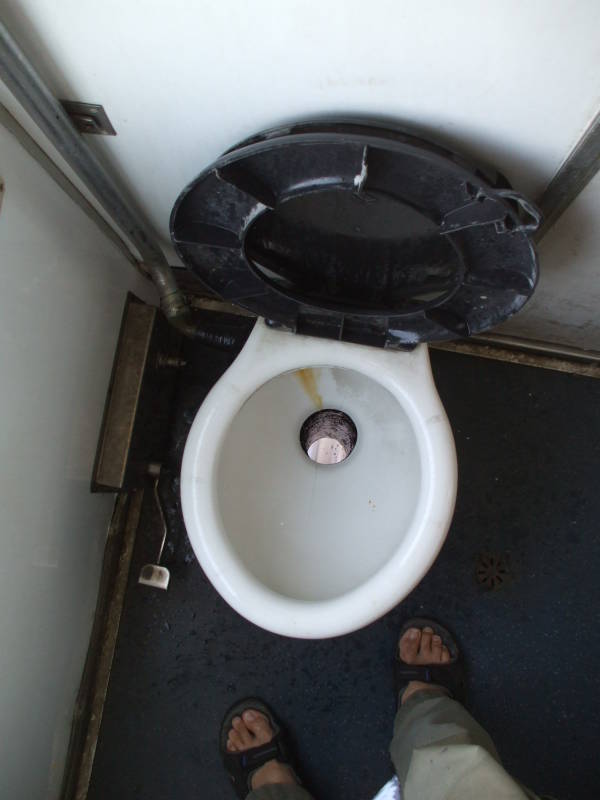
This is the worst train toilet I have ever encountered, on a regional Italian train out of Firenze.
It looks ordinary — a simple drop straight onto the track. But...
The problem is that the drain pipe is directional. It is supposed to draw air down the pipe like a chimney, pulling waste and air down the toilet, out of the compartment and onto the tracks.
The problem was that this one was forcing air up the pipe, with an effect that you can probably imagine but might prefer not to.
Full speed operation forced a very brisk air flow up the pipe. The result was a high-speed urine fountain. Closing the seat and lid just slightly changed the direction of flow — rather than spraying straight up, it now came out horizontally about knee high. The high air speed made for very fine droplets that more easily stayed airborne.
By the time we got into the next city, the interior of the toilet compartment had been coated in a fine mist of urine. It was a fairly long trip, people had had to use it and recharge the fountain.
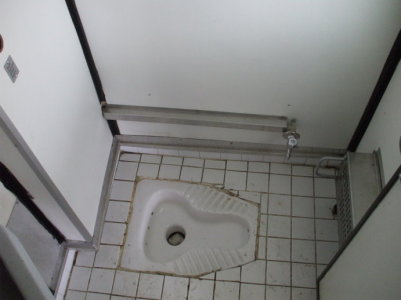
Are there squat toilets in trains? Yes! Here is an example on board a Turkish train running between İstanbul and Bucharest.
TrainToilets
The dedicated train toilet page contains many more examples. Trains running through Belgium, Bulgaria, China, the Czech Republic, Egypt, France, Greece, Hungary, Italy, Latvia, Romania, Russia, Turkey, U.K., and U.S.A.
Subways
This toilet, urinal and sink are in the public restroom in the Delancey Street — Essex Street station of the New York City Subway system.
SubwayToilets
Learn about the world's largest subway system and its seventh busiest, with 209 miles or 337 kilometers of routes and over 1,650 million passenger ride every year.
Public toilets are not generally available, but some stations have them if you know where to look.

Buses
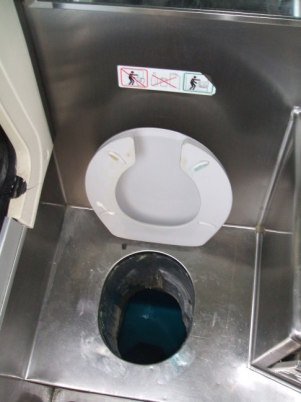
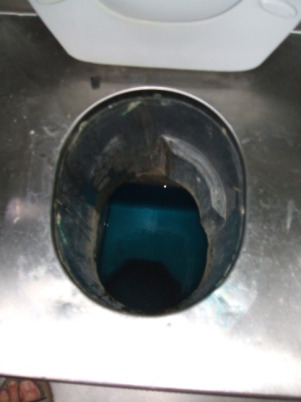
Greyhound buses in the U.S. have on-board toilets. They have a holding tank with the traditional blue juice. I was surprised to see that the design is just a straight drop down a wide shaft into the tank. I would think that the toilet could get awfully smelly on a long hot trip. There is a small air vent directly to the exterior just to the right of your head if you were sitting on the seat.
The toilet compartment occupies the right half of what would be a full-width rear bench seat and what would be the pair of seats just in front of that on the right side of the aisle.
Citylink buses connect cities and towns within Scotland.
BusToilets
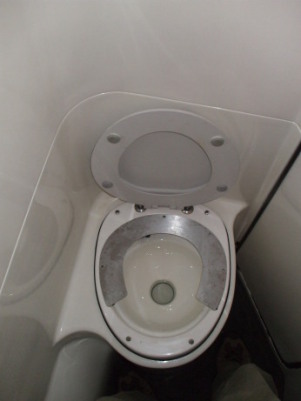
As bus toilets go, these are the nicest that I have encountered. They are constructed about like aircraft toilets, and they are very clean.
The dedicated bus toilet page includes other examples of toilets on board buses in the U.K, U.S.A., and Greece.
Ships
Ships have toilets, properly called heads. See the dedicated page for the explanation of the term "head".
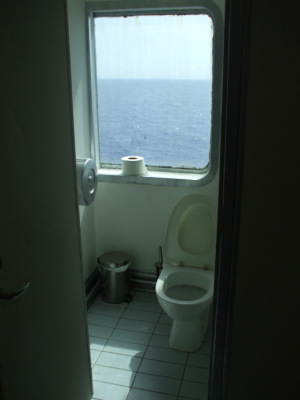
This scenic head is on board the F/B Artemis Greek ferry en route from Ios to Santorini in the Aegean.
What a view! You can look out from three decks above the waterline.
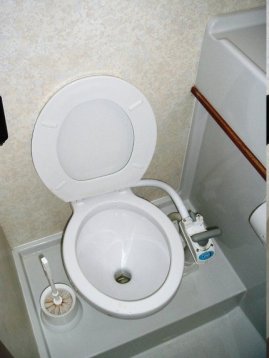
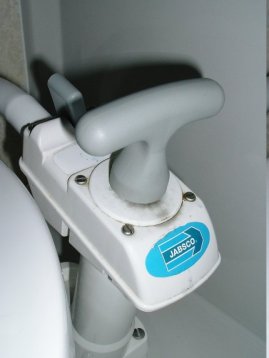
Smaller vessels also have heads, but they are smaller and the flushing mechanism may be rather different. Here you see one of the heads and its manual flushing mechanism on board a rented Crusader canal boat in France.
ShipToilets
The dedicated ship toilet page also shows an on-board squat toilet on an Egyptian ferry in the Red Sea, toilets on the Staten Island Ferry and the New York Water Taxi crossing New York Harbor and the East River, and on ferries to islands of the coast of Scotland.
Submarines
During the last month of World War II, a German U-boat was lost due to problems with its toilet. The captain of the U-1206 wanted to use the toilet, and did so without the assistance of one of the on-board engineers qualified in the operation of that particular toilet. The resulting mishap threatened to poison the crew with chlorine gas and forced the submarine to surface during the daytime near the coast of Scotland.
Submarinetoilets
It was quickly spotted by a British aircraft which attacked the sub and damaged it badly enough that it was unable to safely dive.
The captain scuttled the submarine, just 10 days into the only real combat patrol for both the submarine and its captain, and just over two weeks before Hitler's suicide leading to Germany's surrender 8 days later.
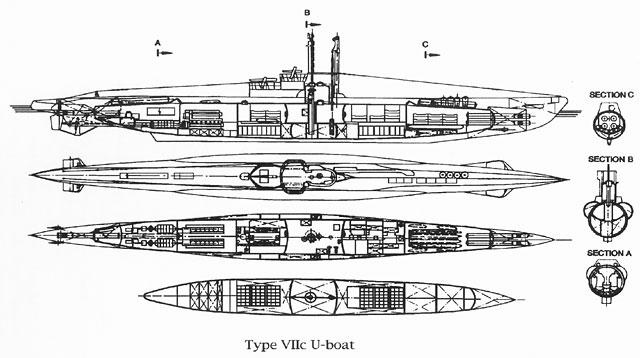
Cross-section diagrams of a German Type VIIc U-boat.
Aircraft
Toilets on airplanes have a distinctive design, but they're all pretty similar to each other. This is one of the toilets along the fuselage centerline on a KLM Boeing 747 flying from Amsterdam to Chicago.
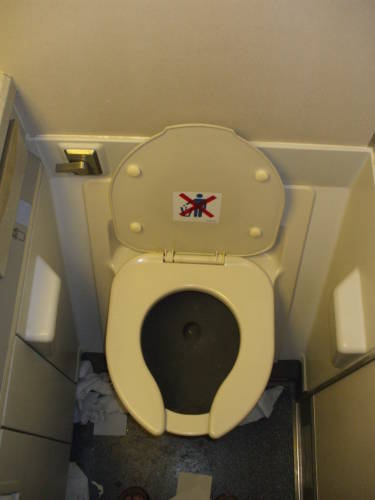
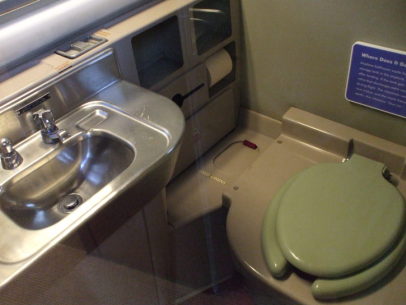
Not only are airplane toilets very similar across several aircraft models, and identical from one airline to the next, they have been very similar for a long time.
Here we see the port lavatory in a Douglas DC-7 at the Smithsonian's National Air and Space Museum in Washington, D.C., USA.
The DC-7 was the last major piston-engined transport made by Douglas, built from 1953 to 1958. Back in 1953, American Airlines charged $302 for a round-trip ticket — New York to Los Angeles and return.
The dedicated aircraft toilet page also includes the lavatories on board Air Force One, the special transport aircraft used by American presidents.
Spacecraft
Remember that these pages document toilets that I have seen. While I haven't gone into space, I have been to aerospace museums. And so I have some pictures of space toilets and related equipment. See the dedicated spacecraft toilet page for several answers to the question, "How to you go to the bathroom in space?"
These pictures are from the Smithsonian's National Air and Space Museum in Washington, D.C., USA.
Here we see the "Human Waste Disposal Units" from two Soviet/Russian spacecraft. At left is the unit from the Mir (or Мир) space station, and at right is the unit from the Soyuz (or Союз) spacecraft.
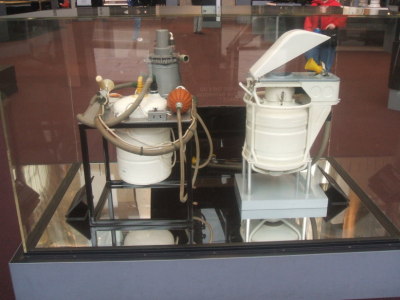
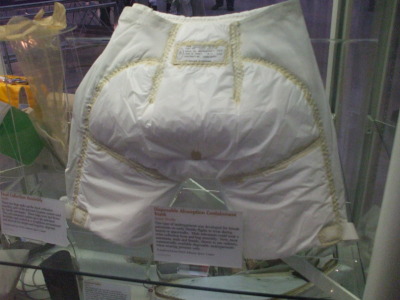
Not all spacecraft have toilets. In fact, most don't. Astronauts and cosmonauts must use something similar to diapers. Or, worse yet, plastic "Fecal Collection Bags".
SpaceToilets
The dedicated space toilet page has examples of various waste collection bags, including several more detailed pictures of the units from Soyuz and Mir, the U.S. Skylab space station, and the U.S. Apollo missions and Space Shuttle.