Paestum and its Plumbing
Paestum and Magna Graecia
Magna Graecia was the Latin for "Greater Greece". The people who settled it would have called it Μεγαλη Ελλας or Megale Hellas, "Greater Greece".
Greek settlers colonized southern Italy and Sicily in the 8th Century BC. It was absorbed into the Roman Republic after the Pyrrhic War (280-275 BC). However, a small population in the "heel" of Italy still speaks Griko, a language combining ancient Doric, Byzantine Greek, and Italian.
A major city was Ποσειδονια, or Poseidonia, called Paestum in classical Roman times and today.
Paestum is south of Salerno, an easy day trip from the Amalfitani coast.
To get to Paestum from Salerno, take the bus. The schedule should be something like what you see here Do check the return schedule carefully, to avoid getting stuck in Paestum overnight!
CTSP bus number 34 runs south through Paestum from Salerno. It leaves from the bus stop along Piazza della Concordia, about halfway from the train station to the ferry pier.
| Salerno | Paestum |
| 0830 | 0940 |
| 0930 | 1040 |
| 1030 | 1140 |
| 1130 | 1240 |
| 1230 | 1300 |
| Paestum | Salerno |
| 1505 | 1610 |
| 1600 | 1710 |
| 1730 | 1840 |
| 2000 | 2105 |
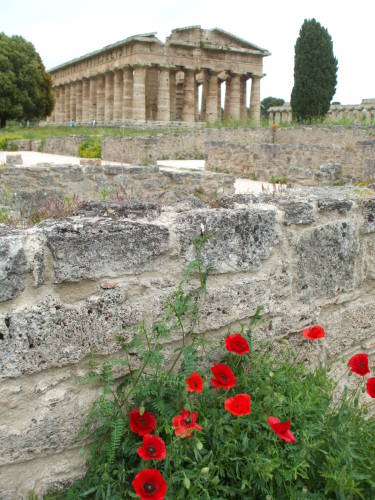
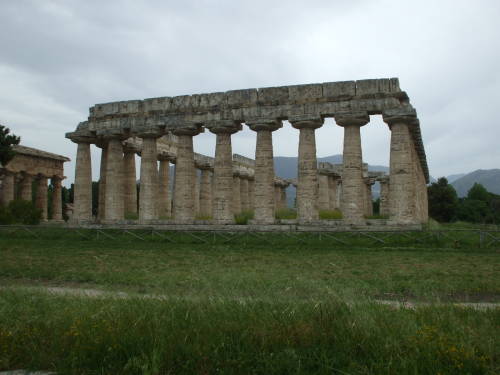
Temple of Hera
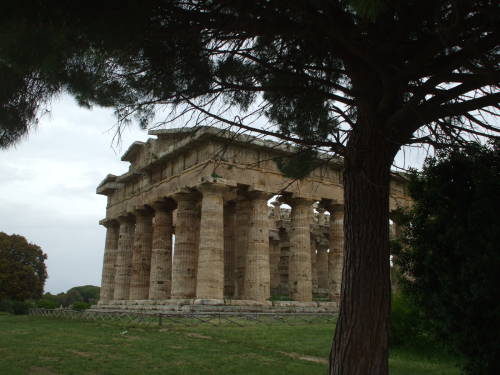
Temple of Apollo.
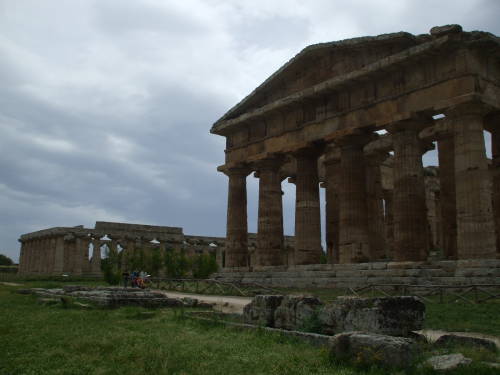
L: Temple of Hera.
R: Temple of Apollo.
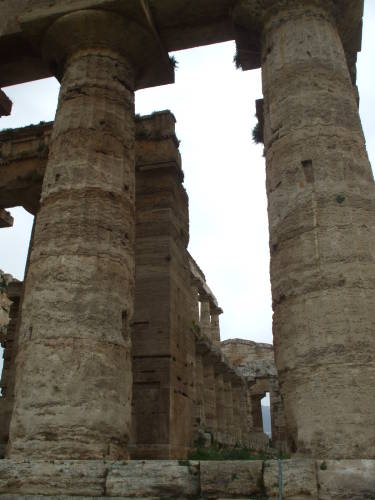
Interior of Temple of Apollo.
The city remained faithful to Rome during Hannibal's invasion of Italy, winning it special favors such as the minting of its own currency. It prospered for centuries, but declined as Rome did.
Paestum was abandoned by the Middle Ages and largely forgotten. Drainage had changed, leading to swampy conditions and malaria.
When Pompeii and Herculaneum were rediscovered in the 1700s, these massive ruins started to get some attention again. Now it's hard to imagine it being abandoned due to its being a malarial swamp, as the area has become pretty dry.
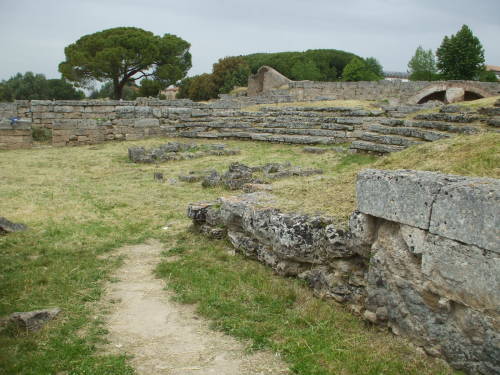
Amphitheatre
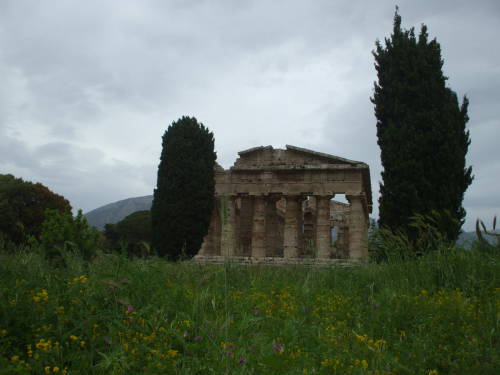
Temple of Athena.
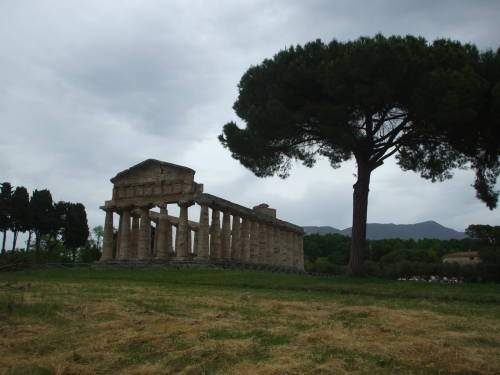
Temple of Athena.
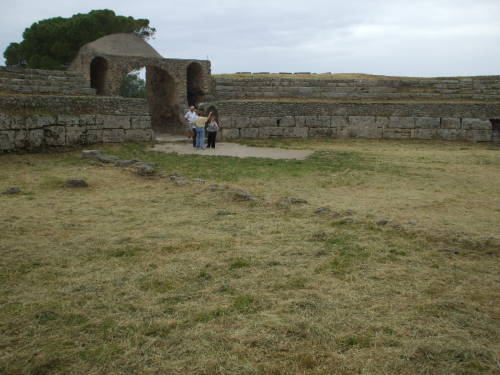
Colosseum.
The Plumbing of Paestum
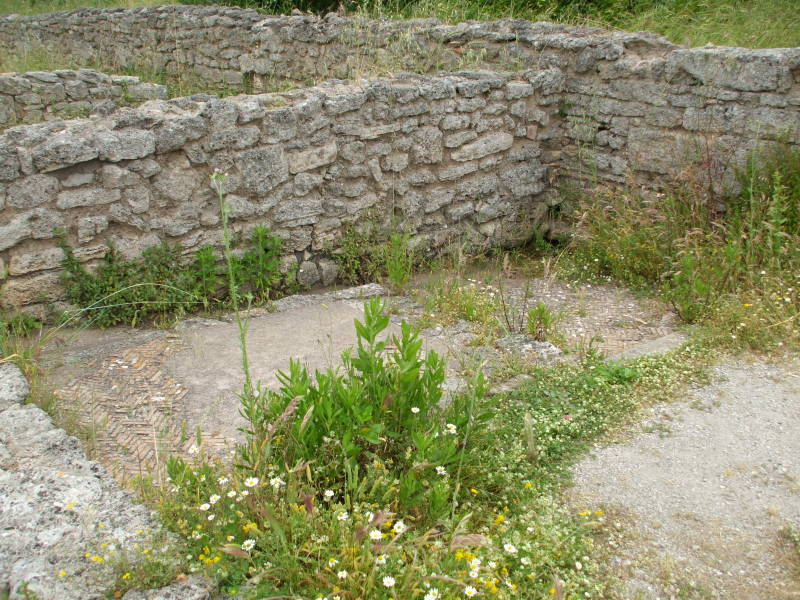
Here is the most likely toilet location I found. It was originally a small room walled into the rear corner of a house. The exterior walls of the house survive to between knee and waist high. The interior walls appear here as lines of vegetation.
The space in question, back in that corner of low surviving walls, is approximately 1 meter wide by 2 meters deep. There appears to have been a drain out of the structure from that back corner.
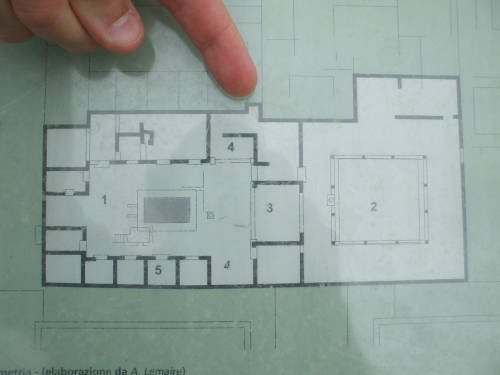
Here is another potential private latrine. It's a small (about one meter wide) chamber off the side of a large home, away from sleeping and food preparation and consumption areas, and away from windows and exterior doors.
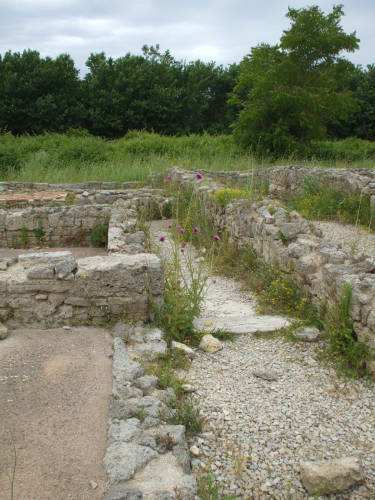
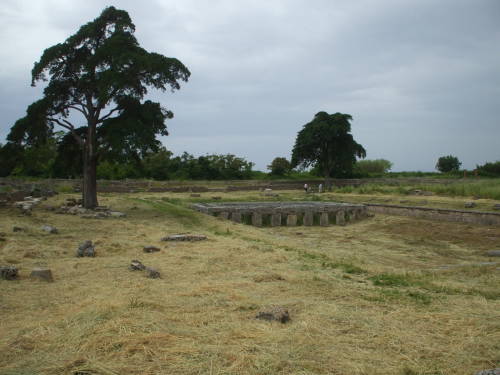
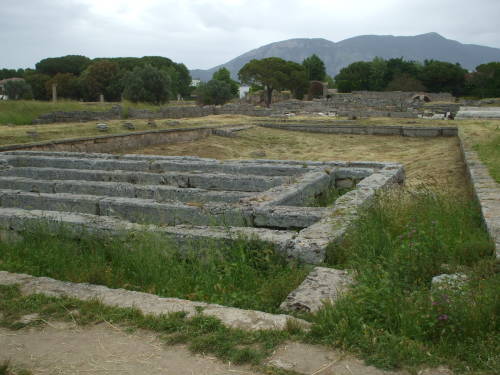
Here you see the supports for the raised and heated floors in one of the major baths in Paestum.
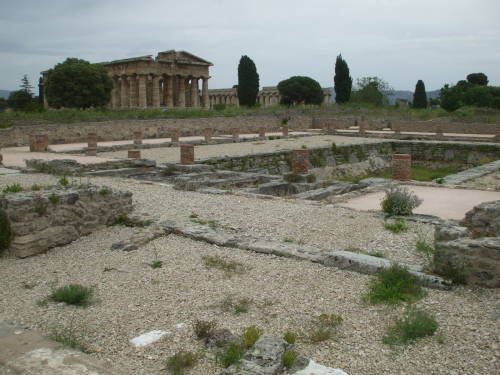
I believe that the below facility was a pool, although it may have been a bath instead.
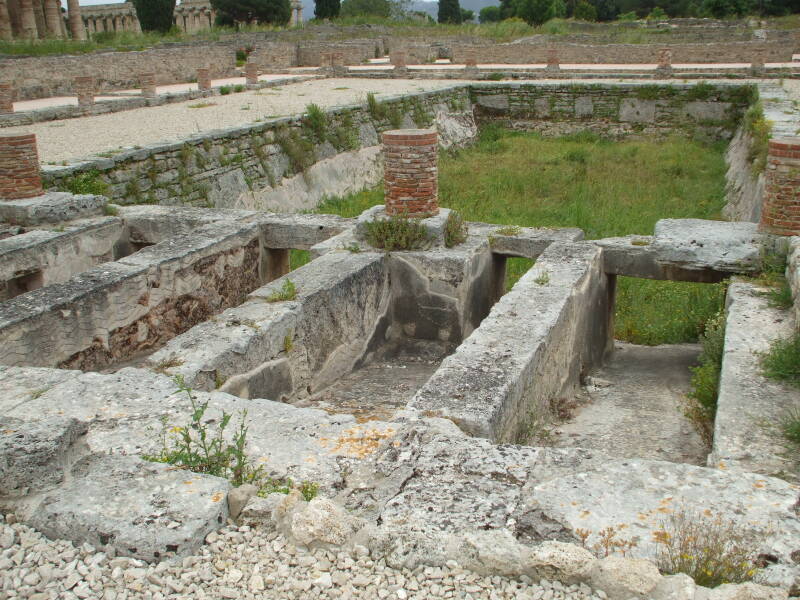
The first picture below is a drain from a smaller bath complex, or possibly part of a public latrine.
The second is a modern public latrine at the Magna Grecia Cafe. It's near the bus stop, a nice place to stop for ice cream (and possibly use the toilet) while waiting for the return bus to Salerno.
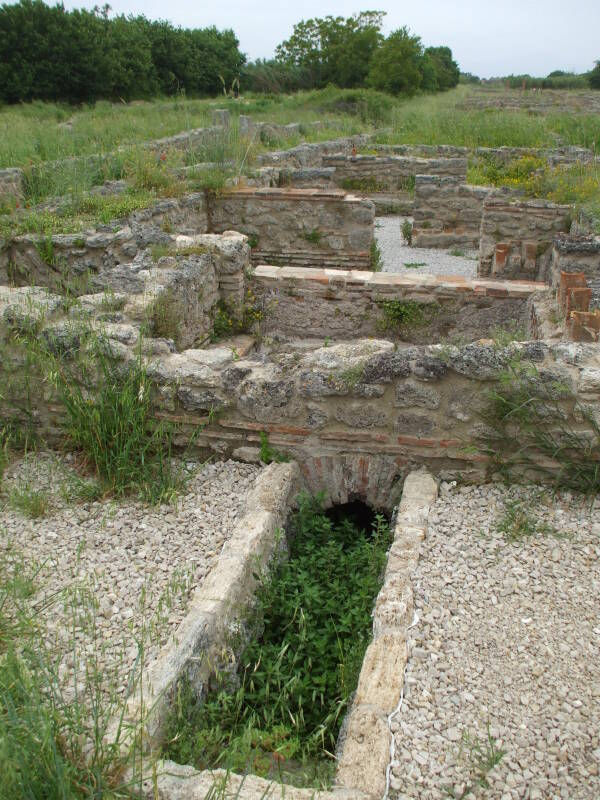
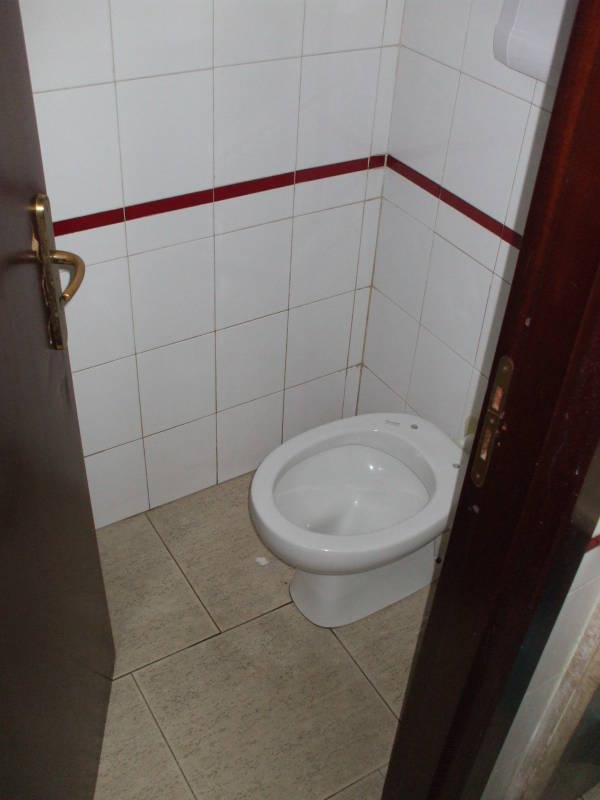
Europeans didn't have toilet paper until recently. The Romans, at least the higher classes, used a tersorium, also called a xylospongium, a sponge mounted on a stick. The sponge could be dipped into a water channel running in front of the row of communal toilets in the latrine, and rinsed off in that channel after use. If there was no channel of running water, a bucket of salt water or vinegar water would be used, as Seneca described in his Letters of Lucillus [70,20].
If neither a tersorium nor water were available, the Greeks and Romans used πεσσοι or pessoi, small stones, to clean themselves. The tradition started with the ancient Greeks that three stones should be enough to finish the job. This convention has been very long lived, with a hādīth attributed to Muhammad specifying three stones as the ideal number for anal cleaning. The pessoi were also used in an ancient board game in Greece. Aristophanes wrote a scene involving pessoi in Peace in the 5th century BCE. Here's the Penguin Classics translation:
Arms dealer [displaying a cuirass]: And what, alack, shall I do with this rounded cuirass, a beautiful fit, worth ten minas?
Trygaeus: Well, that one will not make a loss for you, anyway. Give me that at cost price. It will be very convenient to crap in ...
Arms dealer: Stop this impudent mockery of my goods!
Trygaeus [placing the cuirass on the ground like a chamber pot and squatting on it]: Like this, if you put three stones beside it. Is it not clever?
The Greeks would use όστρακα or ostraka, small pieces of broken ceramic goods, to vote to shun or ban their opponents. This is where we get the word ostracize. Some scholars have suggested that the ostraka could be used as pessoi, literally wiping your feces onto the names of hated individuals. The abrasive characteristics of broken ceramic material suggest that long-term used of these as pessoi could have resulted in localized irritation at the least, progressing to skin or mucosal damage or the irritation of external hemorrhoids. For more on toilet use of pessoi and ostraka and the medical implications see the paper "Toilet hygiene in the classical era", Philippe Charlier, Luc Brun, Clarisse Prêtre, and Isabelle Huynh-Charlier, in BMJ (the British Medical Journal) 2012, pages 345-346.
Operation Avalanche:
The Salerno Landing of 1943
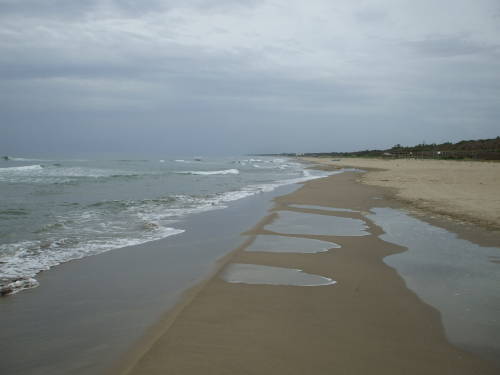
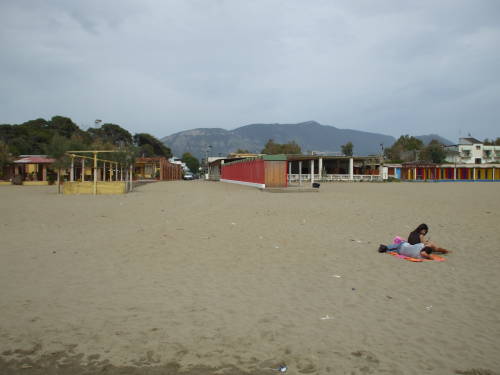
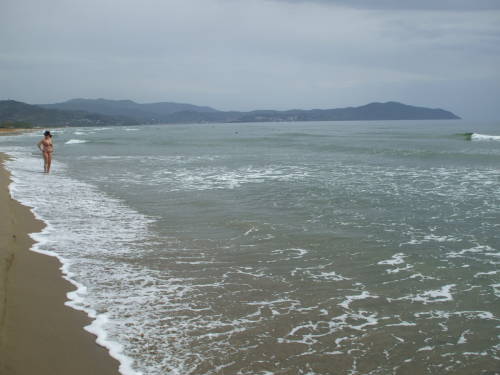
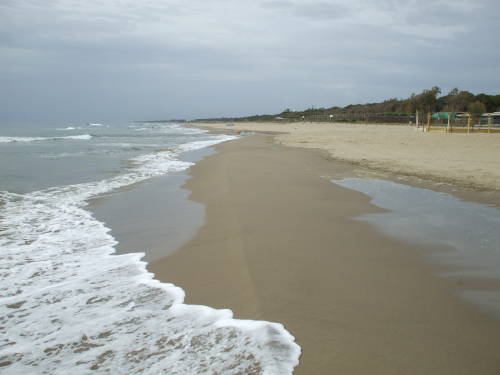
When you're done seeing the ancient history at Paestum, it's just a short 1.5 kilometer walk to the beach and the site of the 9 September 1943 landing of the U.S. 36th Infantry Division during Operation Avalanche, the Allied invasion of Italy.
After the defeat of the Axis Powers in North Africa, the Allies disagreed as to the next step. Winston Churchill especially wanted an invasion of Italy, "the underbelly of Europe". However, General George Marshall and most American planners wanted to avoid all delay of the Normandy invasion.
When it became clear that the Normandy invasion could not happen until 1944, Operation Husky, the invasion of Sicily, was approved. It happened in July 1943 and was very successful, soon followed by a coup deposing and imprisoning Benito Mussolini.

U.S. Army of the 1943 invasion, click here for a detailed version.

U.S. War Department map of the 1943 invasion, click here for a detailed version.
Rather than try to gradually move up the rugged Italian peninsula, the Allies wanted to take the major port at Napoli (Naples). However, Napoli was beyond (or just barely at) the range limit for Allied air cover. The beaches south of Salerno were a little closer, and they provided much better landing opportunities as shown below.
The U.S. 36th Infantry Division landed right at Paestum, and the initial hours of the battle passed through the ruins.
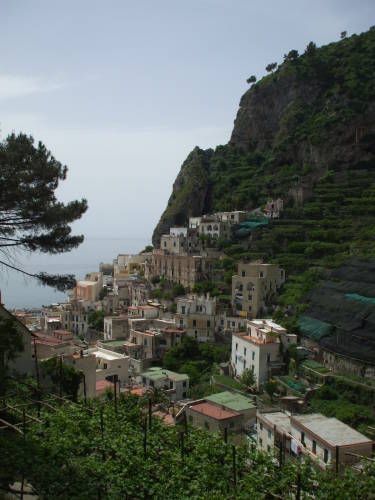
Atrani, on the Amalfitani coast west of Salerno.
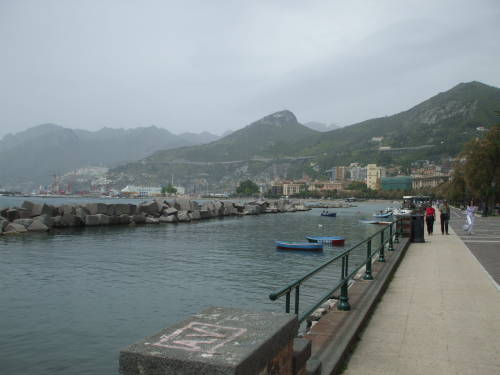
The coastline above the Salerno harbor.
As shown on the map, most of the forces landed on the relatively flat river deltas south of Salerno. The coast west from Salerno through Amafi to the tip of the peninsula is very rugged, with cliffs and nearly vertical slopes 100 to 200 meters high and only very small beaches or piers at a few towns. See my pictures of the coast at Salerno and to its west for why landings on the Italian coast have limited choice.
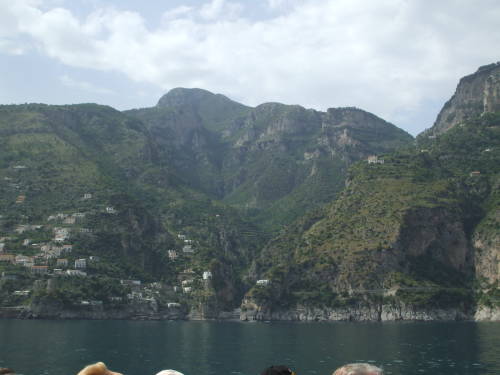
Amalfitani coast between Positano and Amalfi, west of Salerno.
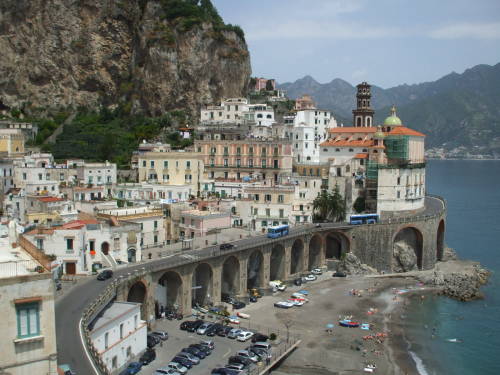
Atrani, on the Amalfitani coast west of Salerno.
The invasion went well.
However, the following war up the length of the Italian peninsula was brutal.
The German forces had been in place for a few years, and had had plenty of time to plan and build defenses.
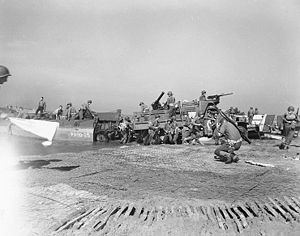
U.S. Navy photograph of the Salerno landing beach, click here for a detailed version.

The Allies slowly pushed them north up the peninsula, but it was a matter of hard fighting for each defensive line (typically along a river running down from the central Apennines to the coast). The Germans would then fall back to their next hardened defensive line.
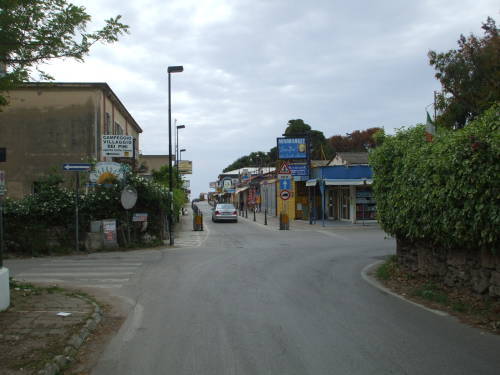
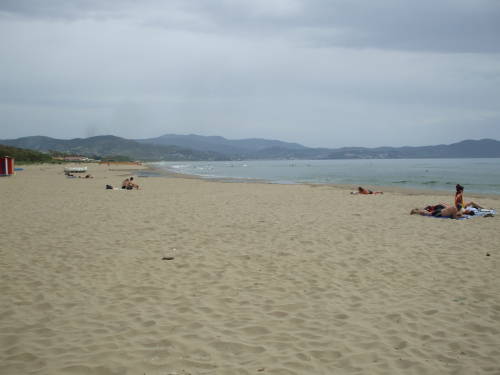
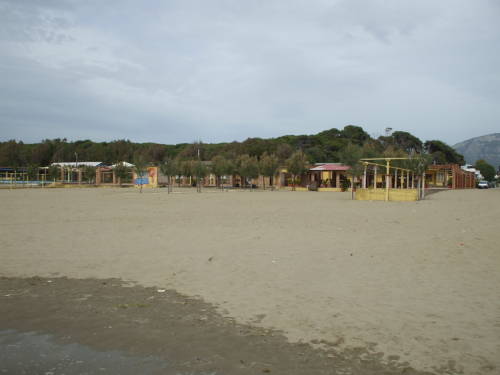
Today the beach near Paestum is a holiday spot. You see the restaurants and cafes as you approach from Paestum.
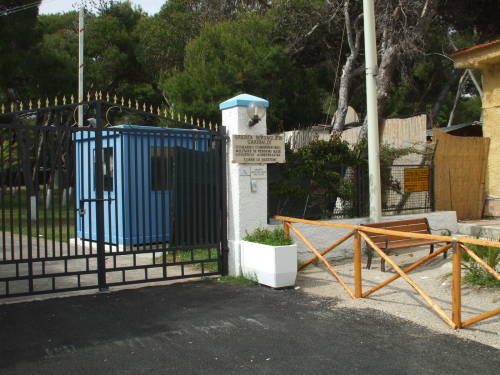
One reminder of its heritage is the small Italian military logistics facility there.