American Revolutionary Toilets

Ben Franklin's toilet.

Ben Franklin's toilet.

At top, the toilet from Ben Franklin's house in Philadelphia.

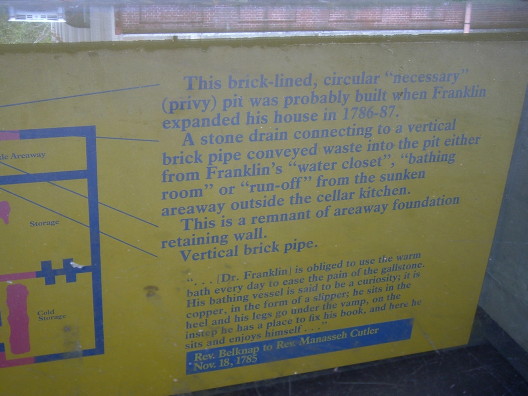
Below that, a nearby sign saying: This brick-lined, circular "necessary" (privy) pit was probably built when Franklin expanded his house in 1786-1787. A stone drain connecting to a vertical brick pipe conveyed waste into the pit either from Franklin's "water closet", "bathing room", or "run-off" from the sunken areaway outside the cellar kitchen. This is a remnant of areaway foundation retaining wall. Vertical brick pipe. [all those calling out areas on a floor plan]

And also: "... [Dr. Franklin] is obliged to use the warm bath every day to ease the pain of the gallstone. His bathing vessel is said to be a curiosity; it is copper, in the form of a slipper; he sits in the heel and his legs go under the vamp, on the instep he has a place to fix his book, and here he sits and enjoys himself ..." Rev. Belknap to Rev. Manasseh Cutler, Nov 18, 1785
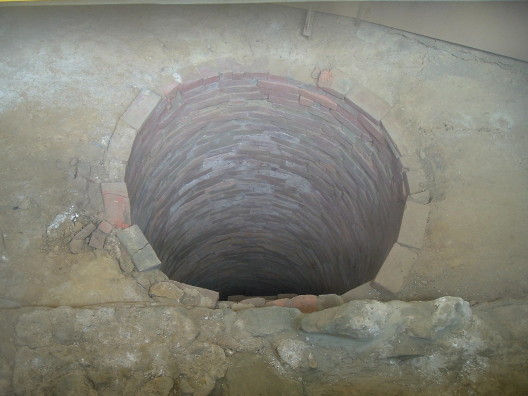
Ben Franklin's toilet.

Ben Franklin's toilet.
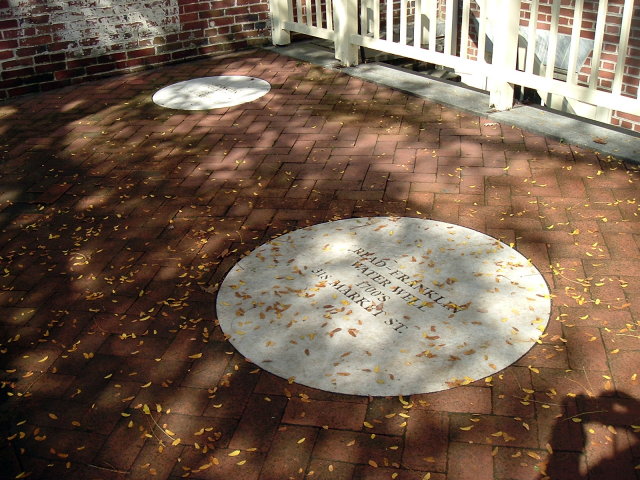
Elsewhere on the same property you find another privy pit and a nearby water well.
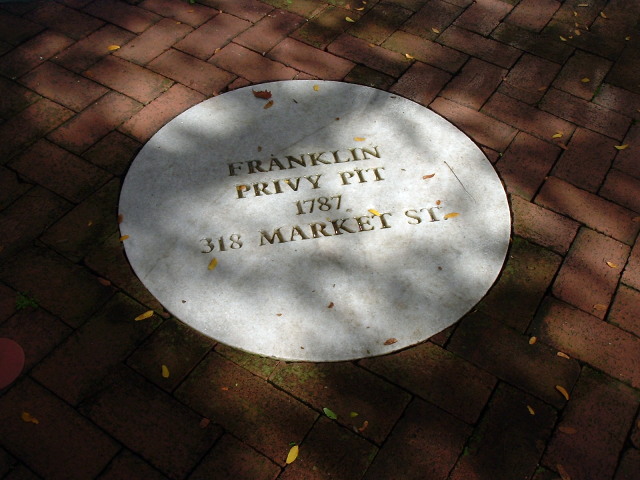
While Benjamin Franklin was clearly a genius in some areas, the very close spacing of a drinking water well and privy pit on his property makes you wonder what he was thinking...

Share this site!


Rose George's The Big Necessity: The Unmentionable World of Human Waste and Why It Matters is a fascinating description of sanitation conditions around the world. "2.6 billion people don't have sanitation. [....] Four in ten people have no access to any latrine, toilet, bucket, or box."

In September 2009, Morna Gregory and Sian James published a book titled Toilets of the World. It's pretty much the same theme that you find here — photographs and commentary on other people's plumbing.

The Porcelain God: A Social History of the Toilet, by Julie Horan, contends that civilization began with the toilet.

Toilet: Public Restrooms and the Politics of Sharing, edited by Laura Noren and Harvey Molotch, has essays by anthropologists, sociologists, and architects on the importance of the toilet, especially for urban dwellers.

Latrinae Et Foricae: Toilets in the Roman World describes the toilets of the Roman Empire from Iberia to Syria, and from North Africa to Hadrian's Wall in Britannia.

Toilets, Bathtubs, Sinks, and Sewers: A History of the Bathroom, explains the history of personal cleanliness and hygiene to children in grades 5-8.

             A Sani-Flush blue border indicates a toilet that I've used.

How long have my Toilets of the World pages been around? I'm not exactly sure, although they started in the mid 1990s as a single page on a Purdue University server. The Internet Archive Wayback Machine lets you see what that looked like as far back as January 17, 1999.

My cromwell-intl.com domain appeared in September, 2001, although the Wayback Machine didn't notice its one enormous Toilet of the World page until January 17, 2002. Some time soon after that I split it into categories, and the collection has grown ever since.

In December, 2010 I registered the toilet-guru.com domain and moved the pages to a dedicated server.

If you're not bored yet, you might be interested in (or at least tolerate):

Click here to inquire about advertising on this or any page on this site.
Home Unix/Linux Networking Infosec Travel Technical Radio Site Map Contact

Use /bin/vi! Manipulate images with ImageMagick! Hosted on Linux
Hosted on Apache This site is viewable with any browser Valid XHTML 1.0! Valid CSS!
© Bob Cromwell Feb 2012. Created with /bin/vi and ImageMagick, hosted on Linux with Apache.     Privacy policy available here.