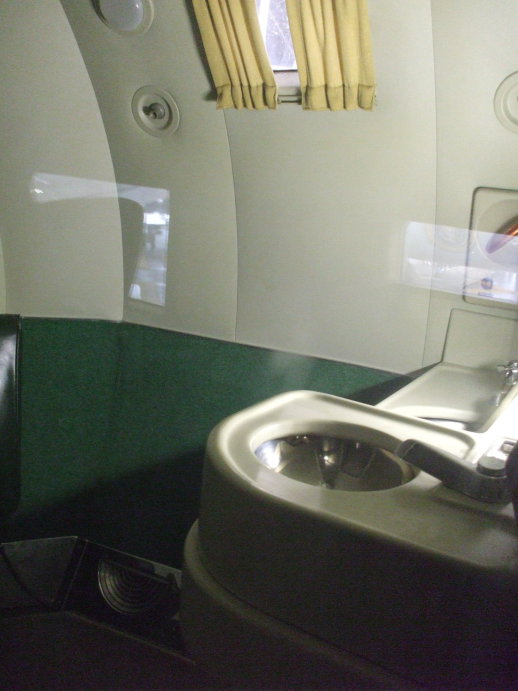
Harry S Truman's Airborne Toilets

U.S. Vice-President Harry Truman assumed the office of President upon the death of Franklin D. Roosevelt in 1945, and won re-election in 1948, serving as U.S. President from May, 1945 through January, 1953.

A Douglas C-54 Skymaster was the first purpose-built U.S. Presidential aircraft. This four-engined transport was introduced in 1942, derived from the civilian DC-4. In 1944, a C-54A was converted to a Presidential transport version for Roosevelt. It came to be known as the Sacred Cow.

Truman also used the Sacred Cow, signing the National Security Act of 1947 on board it and creating the U.S. Air Force. Soon after that, a new Presidential transport was completed.

Truman's new transport had the military designation of a VC-118, a VIP transport conversion of a C-118, which was the military designation for a Douglas DC-6. That was the most advanced airliner available at the time. The newly created USAF commissioned the aircraft on July 4, 1947.

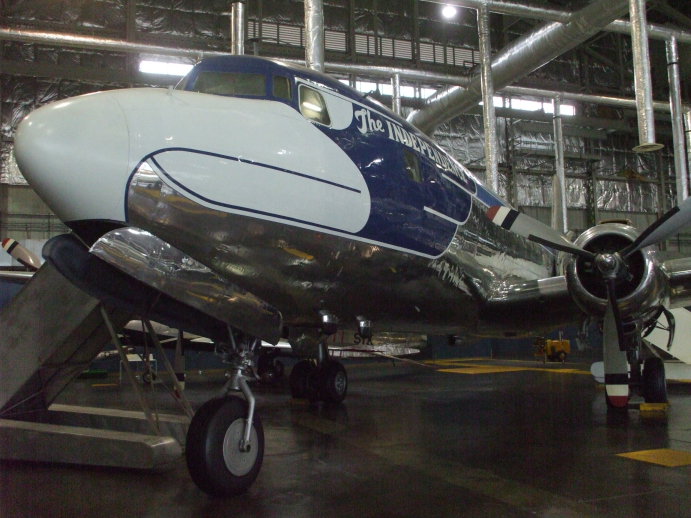
Harry S Truman's VC-118 / DC-6 airplane the 'Independence'.

Douglas Aircraft had begun building the plane for American Airlines. The airline agreed to give it up before the interior was completed. The Presidential unit had a distinctive eagle decorative motif. American Airlines had originally rejected the design, but the U.S. Air Force like the idea of the national bird on the national leader's aircraft.

The name Independence was coined by Presidential pilot Lieutenant Colonel Henry Myers, who also flew the Sacred Cow, to reference both patriotism and Truman's hometown in Missouri.

This VC-118 flew in Presidential service for nearly six years, from 1947 through 1953. One of its most notable flights was in October 1950, when it carried President Truman to Wake Island, northwest of Hawaii in the Pacific Ocean. Truman met there with General Douglas MacArthur.
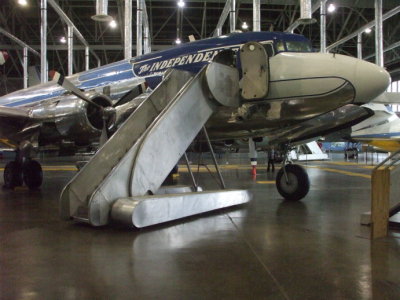
It had four Pratt and Whitney R-2800 engines with 2,400 horsepower each. They provided a maximum speed of 360 mph, a range of 4,400 miles, and a ceiling of 31,200 feet.

After its Presidential service ended in 1953, this aircraft continued as a VIP transport until 1965. It was then retired to the National Museum of the U.S. Air Force at Wright-Patterson Air Force Base outside Dayton, Ohio.
Harry S Truman's toilet on board his airplane.

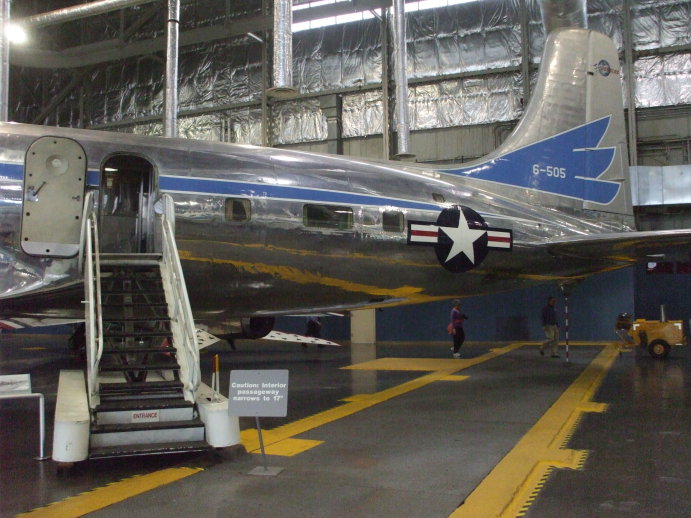
The VIP cabin was at the rear of the fuselage, behind the rear entry door.

The private Presidential lavatory is shown here. It's on the right side of the fuselage.
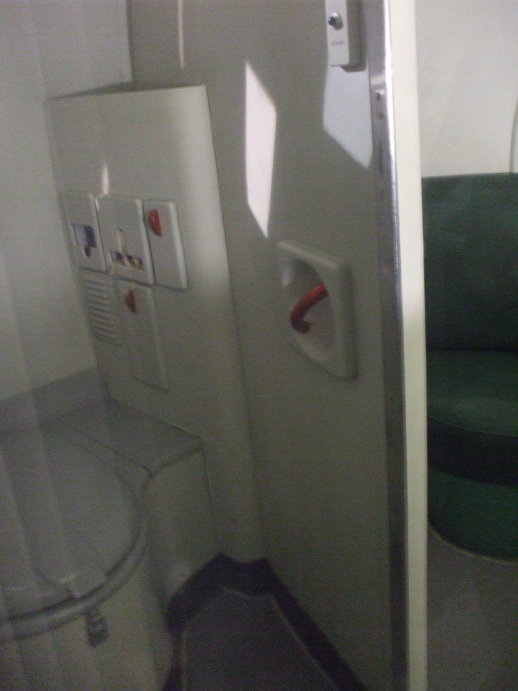
Harry S Truman's washbasin and lavatory on board his airplane.

A washbasin is on the opposite side of the fuselage in the VIP cabin.

The small window is the rearmost one, visible in the above picture of the exterior of the rear of the fuselage.

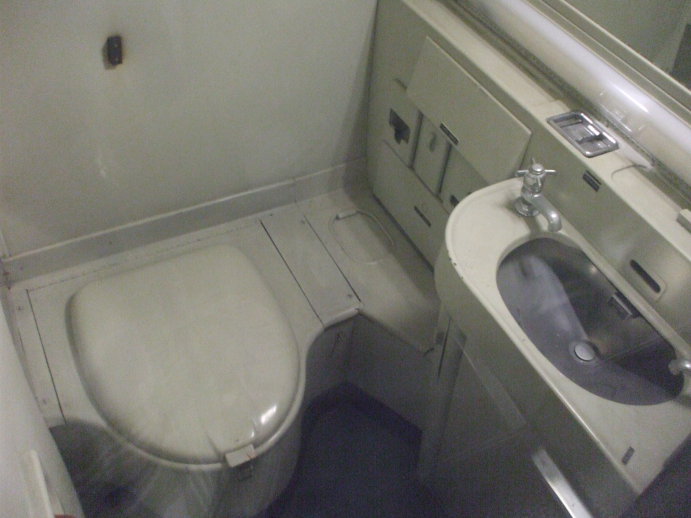
Harry S Truman's washbasin and lavatory on board his DC-6 class airplane.

The forward section of the fuselage contains meeting areas, seats for staff, and even bunks for overnight trips.

It also includes this general use lavatory for his staff and the aircraft crew.

Share this site!


Rose George's The Big Necessity: The Unmentionable World of Human Waste and Why It Matters is a fascinating description of sanitation conditions around the world. "2.6 billion people don't have sanitation. [....] Four in ten people have no access to any latrine, toilet, bucket, or box. [....] Poor sanitation, bad hygiene, and unsafe water — usually unsafe because it has fecal particles in it — cause one in ten of the world's illnesses. [....] Diarrhea — nearly 90 percent of which is caused by fecally contaminated food or water — kills a child every fifteen seconds. The number of children who have died from diarrhea in the last decade [1998-2008] exceeds the total number of people killed by armed conflict since the Second World War.

In September 2009, Morna Gregory and Sian James published a book titled Toilets of the World. It's pretty much the same theme that you find here — photographs and commentary on other people's plumbing.

The Porcelain God: A Social History of the Toilet, by Julie Horan, contends that civilization began with the toilet.

Toilet: Public Restrooms and the Politics of Sharing, edited by Laura Noren and Harvey Molotch, has essays by anthropologists, sociologists, and architects on the importance of the toilet, especially for urban dwellers.

Latrinae Et Foricae: Toilets in the Roman World describes the toilets of the Roman Empire from Iberia to Syria, and from North Africa to Hadrian's Wall in Britannia.

Toilets, Bathtubs, Sinks, and Sewers: A History of the Bathroom, explains the history of personal cleanliness and hygiene to children in grades 5-8.

             A Sani-Flush blue border indicates a toilet that I've used.

How long have my Toilets of the World pages been around? I'm not exactly sure, although they started in the mid 1990s as a single page on a Purdue University server. The Internet Archive Wayback Machine lets you see what that looked like as far back as January 17, 1999.

My cromwell-intl.com domain appeared in September, 2001, although the Wayback Machine didn't notice its one enormous Toilet of the World page until January 17, 2002. Some time soon after that I split it into categories, and the collection has grown ever since.

In December, 2010 I registered the toilet-guru.com domain and moved the pages to a dedicated server.

If you're not bored yet, you might be interested in (or at least tolerate):

Click here to inquire about advertising on this or any page on this site.
Home Unix/Linux Networking Infosec Travel Technical Radio Site Map Contact

Use /bin/vi! Manipulate images with ImageMagick! Hosted on Linux
Hosted on Apache This site is viewable with any browser Valid XHTML 1.0! Valid CSS!
© Bob Cromwell May 2012. Created with /bin/vi and ImageMagick, hosted on Linux with Apache.     Privacy policy available here.